
Trending Coins and Tokens🔥


Crypto
Exchange


TL;DR Top crypto tax friendly options in 2026 include the UAE, Singapore, Germany, Portugal, and Switzerland. Bahrain, Georgia, Hong Kong, Czech Republic, and Puerto Rico may suit specific residency, holding period, or US citizenship cases. Offshore options like Cayman, Bermuda, Bahamas, BVI, and Gibraltar can be tax efficient but are less practical for many people.
Quick Answers to Common Crypto Tax Misconceptions
- A crypto tax free country rarely means zero tax on every crypto activity.
- Private investment gains, trading income, staking, mining, salaries, VAT or GST, corporate tax, and wealth tax can be treated differently.
- For most readers, the practical shortlist is UAE, Bahrain, Georgia, Germany, Portugal, Czech Republic, Switzerland, Singapore, Hong Kong, Malta, Puerto Rico, and Thailand.
- Low population offshore options such as Cayman Islands, Bermuda, Bahamas, BVI, and Gibraltar can be useful, but they are less practical for many residents due to cost, banking, substance, and lifestyle constraints.
- CARF and DAC8 do not remove tax benefits. They make weak residency claims and undocumented gains riskier.
OGAudit reading method
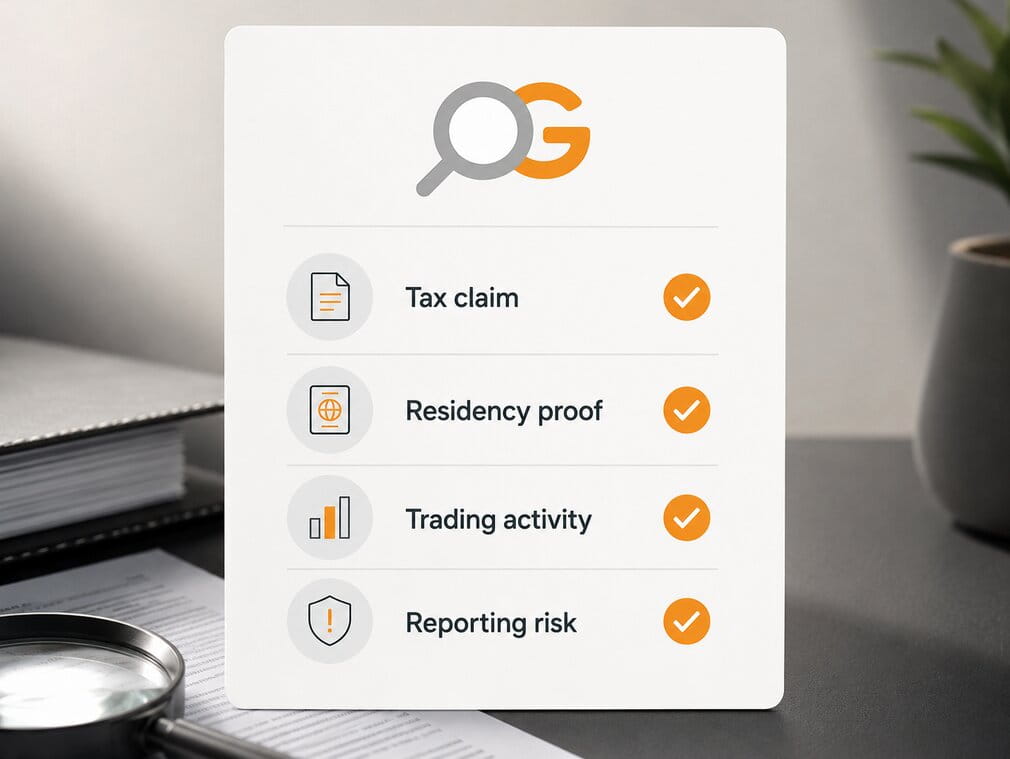
- We rank each jurisdiction by observable rules, not by tax haven marketing.
- Core signals: individual capital gains treatment, residency burden, activity classification risk, corporate tax exposure, and reporting transparency.
- A country is useful only if the tax rule matches the user behavior. Long term holding is not the same as day trading, staking, mining, payroll income, or operating a crypto business.
- Before relocating, verify residency, source rules, pre move gains, exchange reporting, and whether your activity looks like a business.
Global reporting update: CARF and DAC8
CARF was created by the OECD and endorsed as a global tax transparency standard by the G20 and the OECD Global Forum. DAC8 is the EU version, adopted through the European Union’s tax transparency rules. They are not new crypto taxes. They are reporting rules. Crypto platforms must collect user tax residency data and report crypto activity to tax authorities.
- OECD CARF: The OECD Global Forum list updated on 19 February 2026 shows 47 jurisdictions planning first exchanges by 2027, 28 by 2028, and 1 by 2029, for 76 committed jurisdictions in total.
- EU DAC8: EU crypto asset service providers apply crypto tax transparency rules from 1 January 2026, with first reporting in 2027.
- Practical result: jurisdiction choice still matters, but real relocation, clean records, and correct tax residency matter more than before.
Sources: OECD CARF commitment list, European Commission DAC8
Practical Relocation Jurisdictions with Strong Crypto Tax Advantages
United Arab Emirates (UAE)
- Status: Strong zero personal tax option for private crypto investors.
- Individuals: No personal income tax and no personal capital gains tax in ordinary private investment cases.
- Companies: Corporate tax is 9 percent on taxable business profits above AED 375,000 roughly USD 102,100
- Natural persons: Corporate tax can apply only if a person conducts UAE business activity and total turnover from that activity exceeds AED 1 million in a calendar year.
- VAT: Standard VAT is 5 percent. Virtual asset transfer and conversion were added to the VAT exemption framework.
- Key caveat: Stablecoins and fiat backed tokens may need separate VAT classification review. Keep private investment separate from trading business, advisory, mining, exchange activity, or token project income.
Sources: UAE tax overview, UAE corporate tax, FTA natural persons, FTA VAT amendment, VARA

Germany
- Status: Partially tax free for long term private holders.
- Individuals: Private crypto disposals held for more than 12 months are generally tax free under Section 23 EStG.
- Short term gains: Annual private sale gains are taxable if they exceed EUR 1,000. Older guides may still show the previous EUR 600 threshold.
- Income activity: Mining, staking rewards, salaries, and business activity are taxed under separate rules.
- Cost basis: German guidance allows specific allocation where possible and FIFO as a simplification method.
- Key caveat: Good for patient holders, not for active income.
Sources: BMF crypto circular, Section 23 EStG

Singapore
- Status: No capital gains tax with strong business infrastructure.
- Individuals: Long term personal investment gains are generally not taxed.
- Trading: Frequent or systematic trading can be taxed as income.
- Companies: Businesses that accept, issue, or trade digital tokens are taxed under ordinary income tax rules.
- GST: Most digital payment token supplies have been GST exempt since 1 January 2020.
- Reporting: Singapore signed the CARF multilateral agreement and expects CARF exchanges in 2028.
Sources: IRAS digital token income guide, IRAS GST digital payment tokens, IRAS CARF

Malta
- Status: Often tax friendly for capital coin holdings, but fact specific.
- Individuals: Coins held as capital assets can fall outside Maltese capital gains tax in many private investment cases.
- Trading: Frequent trading, business income, mining, and revenue account activity can be taxable.
- Regulation: Malta now anchors crypto regulation in MiCA and the Markets in Crypto Assets Act, Cap. 647.
- Key caveat: Do not describe Malta as blanket crypto tax free. Classification drives the result.
Sources: Malta DLT income tax guidelines, MFSA crypto assets, Markets in Crypto Assets Act Cap. 647

Switzerland
- Status: Tax friendly for private investors, with wealth tax.
- Individuals: Private capital gains on crypto are generally tax free if the activity remains private wealth management.
- Wealth tax: Crypto holdings are still reportable as wealth and subject to cantonal wealth tax.
- Income activity: Mining, staking, airdrops, lending yield, and professional trading can be taxable as income.
- CARF: Swiss CARF implementation cannot start before 1 January 2027, and no Swiss CARF duties apply in 2026 under current SIF guidance.
- Key caveat: The common 5 factor safe harbour is a risk test, not a magic shield.
Sources: Swiss FTA crypto taxation, Swiss SIF CARF framework, Swiss SIF CARF FAQ

Hong Kong
- Status: No capital gains tax, with source and trading analysis.
- Individuals: Long term capital gains are generally not taxed if the asset is held as capital.
- Trading: Business like trading can be taxable as profits.
- Companies: Corporate profits tax is generally 16.5 percent, with territorial source analysis.
- Reporting: Hong Kong is preparing CARF implementation with exchanges planned from 2028.
- Key caveat: The badges of trade and source principle matter more than the crypto label.
Sources: IRD DIPN 39, Hong Kong CARF consultation, SFC licensed platforms

Bahrain
- Status: Gulf option with no personal income tax and regulated crypto services.
- Individuals: No personal income tax and no capital gains tax in ordinary individual cases.
- Companies: No general corporate income tax outside specific oil and gas activity, but multinational minimum tax developments should be checked for entities.
- Regulation: Crypto asset services are regulated by the Central Bank of Bahrain Crypto Asset Module.
- Key caveat: Licensing, AML rules, and activity classification still matter.
Sources: PwC Bahrain individual tax, PwC Bahrain corporate tax, CBB Crypto Asset Module, OECD CARF list

Georgia
- Status: Simple individual crypto gain exemption, with reporting caveat.
- Individuals: Gains from sale or exchange of crypto are generally treated as non Georgian sourced and outside Georgian personal income tax.
- VAT: Crypto exchange for fiat is generally outside VAT under the cited public ruling framework.
- Companies: Legal entities are taxed under ordinary Georgian rules, commonly 15 percent on distributed profits.
- Reporting: Georgia was listed by the OECD as relevant to CARF but not committed as of 2026.
- Key caveat: Strong for individuals, weaker for entities unless local advice confirms source and activity classification.
Sources: Georgia Tax Code, Crypto tax analysis Georgia, Andersen Georgia crypto tax, OECD CARF list

Portugal
- Status: Long term holder friendly, not tax free for all crypto income.
- Individuals: Private disposals of crypto held for more than 365 days are generally exempt in ordinary cases.
- Short term gains: Disposals under 365 days are generally taxed at 28 percent.
- Exclusions: Security tokens, blacklisted jurisdiction counterparties, staking, lending, mining, and professional trading can fall outside the simple exemption.
- Reporting: Exempt gains may still need annual reporting.
- Key caveat: Crypto to crypto treatment and holding period mechanics should be tracked carefully.
Sources: Law 24 D/2022, Portuguese IRS Code, Portugal crypto reporting note

Czech Republic
- Status: Strong new holding period exemption for disciplined holders.
- Individuals: From 2025, crypto proceeds can be exempt after a 3 year holding period.
- Small proceeds: Annual crypto proceeds up to CZK 100,000 roughly USD 4,800 can be exempt without meeting the 3 year holding test.
- Annual cap: The crypto exemption is capped at CZK 40 million per year.
- 2026 nuance: The CZK 40 million cap was removed for certain securities and shares, but it remains in place for cryptoassets.
- Key caveat: Keep records for acquisition date, disposal date, proceeds, and asset identity.
Sources: BDO Czech crypto exemption update, Crowe Czech exemption limits

Puerto Rico
- Status: Special regime for US citizens who become bona fide residents.
- Individuals: Act 60 can exempt qualifying post residency capital gains, dividends, and interest from Puerto Rico tax.
- Residency: The presence test, tax home test, and closer connection test all matter.
- Crypto source: Crypto is treated as property under IRS Notice 2014 21 and current IRS digital asset guidance.
- Key caveat: Pre move appreciation is not exempt, and weak residency or sourcing facts create IRS risk.
Sources: Invest Puerto Rico Act 60, IRS Notice 2014 21, IRS Puerto Rico residency guide, IRS digital assets

Thailand
- Status: Temporary exemption for qualifying digital asset gains.
- Individuals: Capital gains from qualifying digital asset sales through licensed Thai exchanges, brokers, or dealers can be exempt from personal income tax.
- Timeline: The exemption applies from 1 January 2025 to 31 December 2029.
- Scope: The rule is tied to licensed Thai platforms and does not cover every crypto transaction everywhere.
- Key caveat: Thailand is a specific incentive regime, not a universal zero tax country.
Sources: Tilleke Thailand crypto exemption, PwC Thailand tax news flash
Low population offshore options
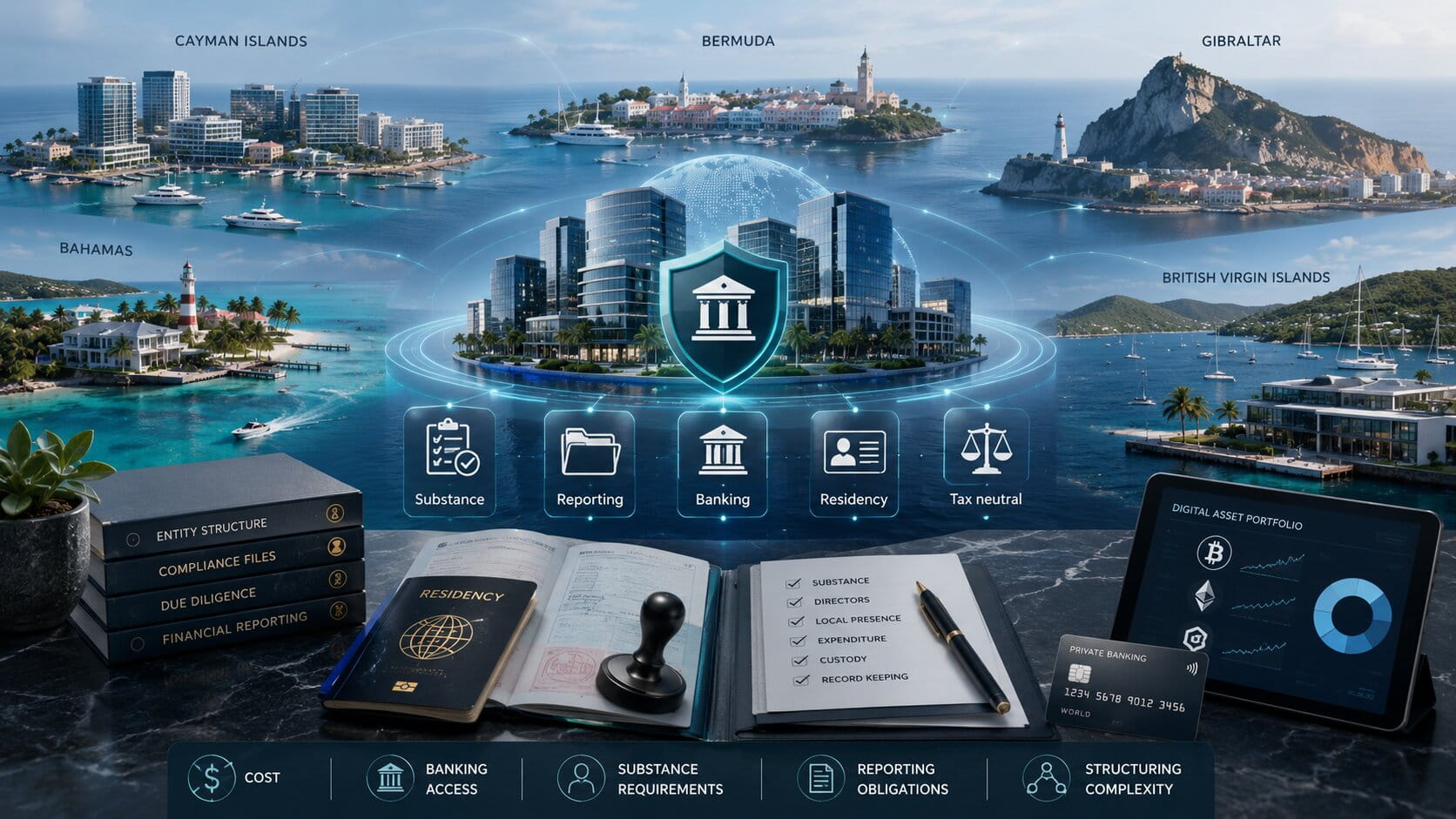
These jurisdictions can be tax efficient, but they are not casual relocation choices because being labelled as offshore jurisdictions. Cost, banking, residency, substance, and reporting can matter more than the headline tax rate.
Cayman Islands
- Status: Tax neutral offshore jurisdiction for individuals and structures with proper substance.
- Details: No income tax, capital gains tax, corporate tax, or inheritance tax.
- Regulation: VASPs are supervised by CIMA under the Virtual Asset Service Providers framework.
- Reporting: CARF and amended CRS rules took effect from 1 January 2026, with first reporting for 2026 in 2027.
- Cost: Import duties are commonly high, often 22 percent to 27 percent on many imported goods.
- Key caveat: Excellent tax profile, but expensive and not a casual relocation choice.
Sources: Cayman tax overview, CIMA VASP FAQ, Cayman CARF notice, PwC Cayman other taxes
Bermuda
- Status: Strong individual zero capital gains story, with entity caveats.
- Individuals: No personal income tax and no capital gains tax for individuals, but payroll tax exists.
- Regulation: Digital asset businesses are regulated by the Bermuda Monetary Authority.
- Companies: In scope MNE groups with annual revenue of EUR 750 million or more face 15 percent corporate income tax from 2025.
- Key caveat: Strong for individuals, but high cost and corporate tax carve outs matter.
Sources: Bermuda taxes, Bermuda corporate income tax, BMA digital asset business
Bahamas
- Status: Tax neutral island option with modern digital asset regulation.
- Individuals: No personal income tax and no capital gains tax.
- Companies: No corporate income tax, but VAT, business license fees, and other indirect taxes can apply.
- Regulation: Digital assets are regulated under the Digital Assets and Registered Exchanges Act 2024.
- Key caveat: Tax neutral does not remove compliance, banking, licensing, or substance questions.
Sources: PwC Bahamas individual taxes, PwC Bahamas corporate tax, Bahamas DARE Act 2024, OECD CARF list
British Virgin Islands (BVI)
- Status: Offshore structuring option, less ideal as a general resident lifestyle answer.
- Details: The BVI is generally tax neutral for BVI business companies, with no income, corporate, capital gains, or withholding taxes on profits.
- Regulation: Virtual asset service providers are regulated under the VASP Act framework.
- Compliance: Economic substance and international reporting rules still matter.
- Key caveat: Useful for entities, funds, and holding structures, but not a simple personal tax residency answer for every investor.
Sources: BVI virtual asset guidance, BVI VASP Act guide, BVI tax neutral summary, OECD CARF list
Gibraltar
- Status: Small regulated jurisdiction with no capital gains tax.
- Details: Gibraltar does not levy capital gains tax or VAT.
- Regulation: DLT providers are supervised by the Gibraltar Financial Services Commission.
- Companies: Companies are taxed on income accrued in or derived from Gibraltar, with corporate tax generally 15 percent.
- Key caveat: Small jurisdiction, strong regulatory story, but not a broad no tax promise.
Sources: Gibraltar tax office, GFSC DLT providers, Gibraltar crypto legal guide, OECD CARF list
Overstated jurisdictions (not directly tax-free crypto gains)
Panama
- Status: Territorial tax analysis, not a clean crypto specific zero tax claim.
- Details: Panama taxes Panama source income and generally does not tax foreign source income.
- Crypto: Foreign venue crypto gains may be argued as foreign source in some cases, but this should not be written as a universal official crypto exemption.
- 2026 update: Law 526 of 2026 introduced economic substance rules for certain foreign source passive income earned by Panamanian entities in multinational groups.
- Timeline: The new economic substance regime is expected to apply from fiscal year 2027, so 2026 is a preparation year for affected structures.
- Key caveat: Keep Panama as case by case, not Tier 1 tax free for crypto investors.
Sources: PwC Panama corporate tax, Baker McKenzie Panama Law 526
Countries should not be marketed as clean crypto tax free havens.
-
El Salvador: popular Bitcoin narrative, but not a clean universal crypto tax free residency answer. Verify current law, incentives, residency, and IMF related policy changes before inclusion.
- Cyprus: use caution. Reform discussions and EU reporting make it unsuitable as a simple tax free claim.
- Malaysia: can be friendly for capital investment, but frequent trading or business activity can be taxable. Not cleaner than Singapore or Hong Kong.
Best Crypto Tax Free Countries Compared Briefly
| Country | Summary |
|---|---|
| UAE | 0 percent personal tax. Stablecoin VAT needs review. |
| Bahrain | 0 percent personal tax. Entity rules matter. |
| Georgia | Often 0 percent for individuals. Not CARF committed. |
| Germany | 0 percent after 12 months. Active income taxed. |
| Portugal | 0 percent after 365 days. Short term gains taxed. |
| Czech Republic | 0 percent after 3 years. CZK 40 million cap. |
| Switzerland | 0 percent private capital gains. Wealth tax may apply. |
| Singapore | No capital gains tax. Business income taxed. |
| Hong Kong | No capital gains tax. Source rules matter. |
| Malta | Often 0 percent for capital holdings. Trading taxed. |
| Puerto Rico | 0 percent Act 60 gains. Residency required. |
| Thailand | Temporary exemption until 2029. Licensed platforms only. |
| Panama | Foreign source income often untaxed. Substance rules apply. |
| Cayman Islands | 0 percent direct tax. High cost and CARF matter. |
| Bermuda | 0 percent individual capital gains. MNE tax caveat. |
| Bahamas | 0 percent personal capital gains. VAT and licensing matter. |
| BVI | Tax neutral structure option. Better for entities. |
| Gibraltar | No capital gains tax. Income tax still exists. |
Bonus: Countries with no broad personal income tax
These jurisdictions do not levy broad personal income tax on individuals. In many cases, that can include private crypto gains unless crypto is explicitly taxed under a separate rule. Still, this does not mean every crypto activity is automatically tax free. Corporate activity, payroll tax, VAT, customs duties, licensing, withholding tax, source rules, and residency rules may still matter.
• Anguilla
• Antigua and Barbuda
• Bahamas
• Bahrain
• Bermuda
• British Virgin Islands
• Brunei
• Cayman Islands
• Kuwait
• Monaco
• Qatar
• Saudi Arabia
• St. Kitts and Nevis
• Turks and Caicos Islands
• United Arab Emirates
• Vanuatu
Final notes to consider
-
Tax rules change quickly. Verify the official source in the relevant jurisdiction and use a qualified tax adviser before moving, selling, reporting, or restructuring
- This article is for research and editorial education. It is not legal, tax, investment, or residency advice.
- Also check which exchanges support off ramping in that country, and make sure you use reliable platforms with no major red flags. Read our crypto exchange red flags and safety checklist to decide which exchange is safest for you.
About the author:
Kripto Raptor is the Chief OG at OGAudit.com and an independent Web3 researcher, blockchain analyst, and entrepreneur. Active in crypto since 2016 and working full-time in the industry since 2020, he specializes in evaluating Web3 and fintech projects through security analysis, community behavior, and market dynamics. At OGAudit, he publishes data-driven research, crypto social audit reviews, and in-depth project evaluations focused on transparency, risk assessment, and real-world performance.
FAQ
Is crypto tax free in the UAE in 2026?
For private individuals, UAE has no personal income tax and no personal capital gains tax. Business activity can still trigger corporate tax.
Is Portugal still a crypto tax haven?
Partly. Long term private disposals over 365 days can remain exempt, while short term gains and income style activity can be taxed.
Does Germany still allow tax free crypto after one year?
Yes. Private disposals held for more than 12 months are generally tax free under Section 23 EStG.
What is the cleanest option for US citizens?
Puerto Rico is the main route that preserves US citizenship, but only for bona fide residents and qualifying post move gains.
Do CARF and DAC8 remove tax free countries?
No. They make reporting, tax residency, and documentation more important.
Should offshore islands be ranked with normal relocation countries?
No. Cayman, Bermuda, Bahamas, BVI, and Gibraltar belong in a separate section because cost, scale, residency, banking, and substance can be bigger practical barriers.


