
Trending Coins and Tokens🔥


Crypto
Exchange

Crypto Exchange Red Flags: 7 Real Failure Patterns and What to Check Before You Deposit

TL;DR: The biggest crypto exchange red flags in 2024 to 2026 are not spectacular hot-wallet hacks. They are slow operational squeezes: arbitrary account freezes, withdrawal friction that builds for weeks before a collapse, liquidation engines with no audit trail, and exchanges that cooperate with law enforcement only on paper. The cases below are documented on-chain and in public complaint records, followed by a practical pre-deposit verification checklist.
Top 5 crypto exchange red flags at a glance:
- Unexplained pauses or delays on stablecoin withdrawals across multiple chains.
- Proof of Reserves that shows assets only and omits customer liabilities.
- A self-issued exchange token making up more than 50% of reserves (treat anything above 30% with caution).
- Arbitrary account freezes with no documented appeal process or resolution timeline.
- Repeated KYC and source-of-funds loops triggered only after a user tries to withdraw profits.
Jump to the pre-deposit safety checklist ↓
Depositing on a CEX is a counterparty-risk decision
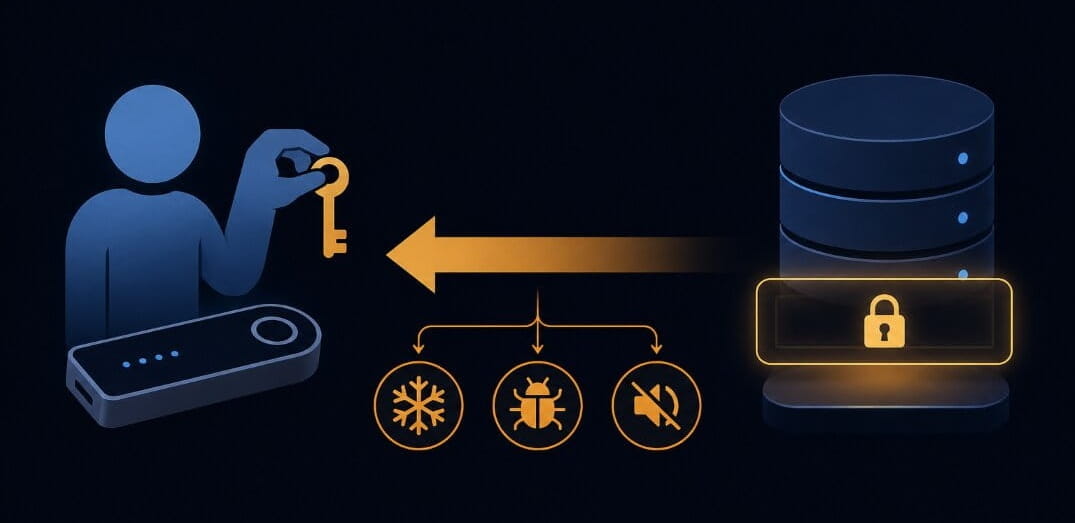
Depositing on a centralized exchange means handing custody of assets to a third party. The exchange holds the keys. The user holds an entry on a database.
That entry can be frozen by a compliance engine, wiped in an exploit, or lost when the exchange quietly stops responding. None of these are theoretical scenarios. The 2022-2023 collapse wave (FTX, Celsius, Voyager, BlockFi) is well documented. The 2024-2026 wave is quieter and procedural: smaller venues going silent, withdrawals pausing under maintenance cover, accounts freezing for compliance reasons that never get explained.
The right mental model is not which exchange has lower fees. It is which counterparty is least likely to fail or freeze me out, and what are the observable signals of trouble before it becomes irreversible.
The cases below are drawn from verified user reports, on-chain transaction records, and public complaint data. Each one exposes a structural pattern that repeats across venues and cycles. At the end, the OGAudit community-verified scoring methodology is linked for readers who want systematic evaluation beyond individual case research.
Based on full-time work in the crypto industry since 2020, careful observation, and external research, I will walk you through the most common types of incidents, real-world examples, and what we can individually do to protect our assets.
How crypto exchanges actually fail: seven documented patterns to watch out for
These are not hypotheticals. Each pattern is named after the structure it describes, with real 2024-2026 cases attached.

Pattern 1: Volume manipulation and fake liquidity
Reported volume is high. Order book is thin. Real orders slip immediately. The liquidity that appeared on the screen at rest disappears the moment a trade executes.
What it hides: an exchange running on borrowed time, using inflated volume figures to attract listings, traders, and ranking placements while the real order book cannot support it.
The pattern is not new. BitForex reported $1.38B in daily volume in early 2023, ranked in the global top 10, and went silent in February 2024 with a reported $56M shortfall and a non-functional order book. The volume number and the underlying reality had been disconnected for months before the collapse became public.
In October 2024 the SEC charged three market makers (ZM Quant, Gotbit, CLS Global) for generating artificial token trading volume on behalf of paying clients. This was the first time the practice was prosecuted directly. Chainalysis subsequently documented retail-facing wash-trading bot services charging 0.212 ETH for a bot that fakes $100,000 of volume in 24 hours.
How to check: place a small market order at the reported size and measure slippage. Compare order book depth to the reported volume number. Sample recent trades for repeated round-number quantities, which is a bot execution tell. On EVM chains, cross-reference reported volume against on-chain inflows. Always check Crypto OG reviews on the OGAudit Exchanges page before trading on any exchange.

Pattern 2: Listing, hype, dump, delist
New token gets listed. Price pumps on listing volume, then bleeds out over 30–90 days. Delisted. Holders are left with a worthless asset on a venue that no longer trades it.
This pattern has intensified with the memecoin era. Cheap to launch, easy to list, easy to delist. Some exchanges cycle through these assets with no apparent concern for what retail holders are left holding.
What it hides: a pay-to-list model where listing fees are real revenue and the incentive points entirely toward volume at listing, not toward long-term asset quality.
BitMart is a documented example of this at scale. In 2024 alone, at least 56 tokens were delisted across confirmed bulk batches (check other announcements too) including names like BABYWIF, MEMEMINT, BIDEN2024, and $DINO. The pace continued into 2025: 50 more in December alone (DTRAB, KONAN, YTC, AIX, among others). Each batch follows the same structure, trading suspended, 60-day withdrawal window, no guaranteed direct notification to holders. Users who miss the window lose access entirely. The exchange frames every batch as platform optimization and compliance. The output is a rotating door of low-quality assets that generate listing-period volume and then disappear.
Binance launched a Vote-to-Delist program in early 2025 and removed 14 tokens in the April 2025 batch (BADGER, BAL, BETA, CREAM, CTXC, ELF, FIRO, HARD, NULS, PROS, SNT, and others). That is a tier-1 venue formalizing community-driven delisting, which is a healthy signal at that level. The concern is listing 50 tokens for every one they delist, with most gone within 90 days of listing.
Not every delisting is indefensible. Dead projects with abandoned teams should be removed. But that same ease of delisting makes it easy to list no-use-case coins, collect listing fees, favor insider trading and delist them a few months later once the price crashes and volume dies.
How to check: pull the exchange's delisting announcements for the last 12 months. Calculate the listing-to-delisting ratio. Check average time-to-delist for removed tokens. The ratio and the timing together are the signal, not either one alone.
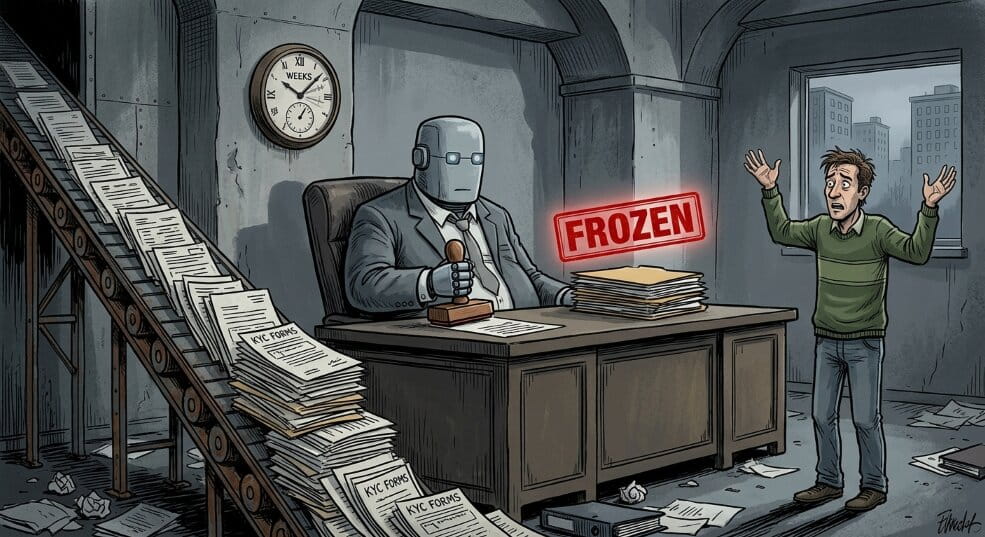
Pattern 3: Arbitrary account freezes and KYC weaponization
Account frozen without specific cause. Support cites security review, compliance, AML, or suspected fraud funds with no detail. Resolution takes weeks to months. Repeat KYC requests cycle indefinitely with no specific deficiency cited.
The most documented case of 2025 is MEXC. In July 2025, pseudonymous trader The White Whale had his account frozen with $3.15 million inside. The stated reason: placing two orders within the same second, flagged as potential automated trading. He denied it. MEXC initially said the funds would be forfeited. After months of public pressure and ZachXBT's involvement, BTC withdrawals on the exchange spiked from 40 to over 1,200 per day. MEXC's CSO publicly admitted fault. MEXC Chief Strategy Officer Cecilia Hsueh said "We fucked up" on X. Funds were returned in October 2025. The White Whale reported receiving hundreds of similar cases from other users with indefinitely frozen accounts. MEXC's own CSO acknowledged the cause: the exchange had scaled into a top-10 venue by volume while its risk and operations teams failed to keep pace.
The case was resolved because the trader had roughly 100K followers and the reach to make it loud. Most users don't. Smaller-scale cases follow the same structure with no path to resolution. Two complaints from early 2026 document the pattern directly: a fully KYC-verified user with 16,000 USDT frozen under "suspected fraud funds" with no transaction detail provided, and a separate account locked for two weeks with 10,000 USDT inaccessible, cycling through proof-of-funds requests with no stated endpoint or document standard. For these cases ZachXBT didn't come for help, and still no resolution.
Interestingly, as seen in the cases enhanced KYC checks, source-of-funds requests, and suspicious-activity flags only appear after large profits or withdrawal attempts. The obvious question is why these requirements were not enforced during onboarding or earlier account activity.
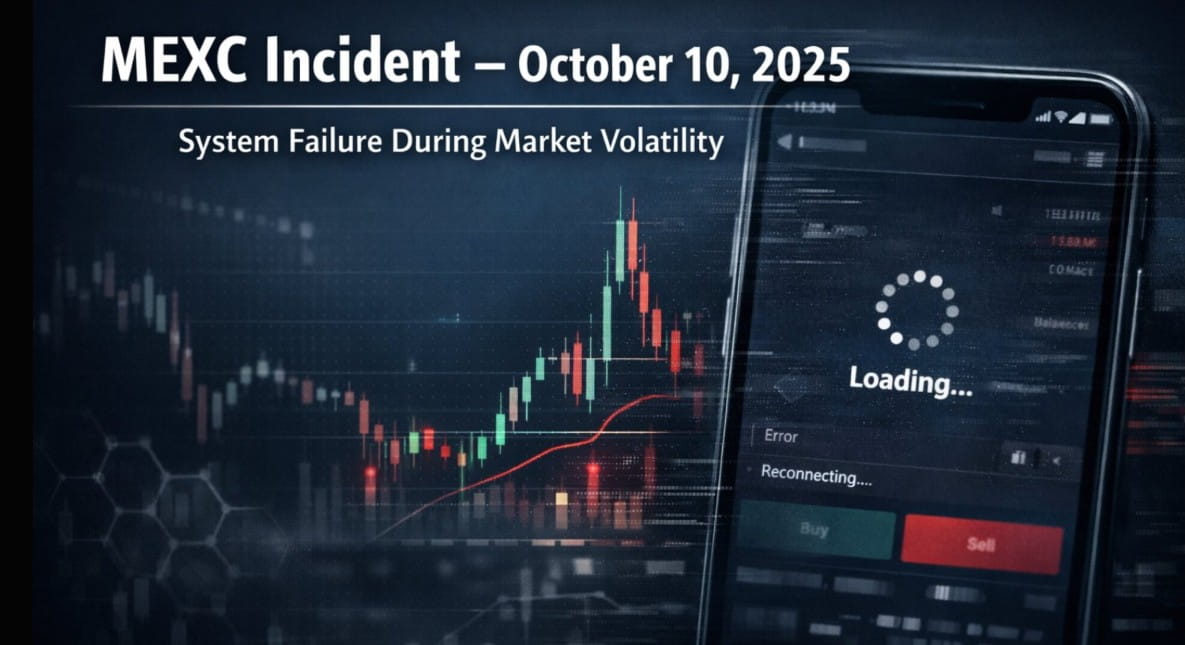
Pattern 4: Liquidation black box (MEXC case: Bohdan Levinskiy)
A Ukrainian trader, Bohdan reported a disputed liquidation on a STRK futures position at MEXC in Oct 2025, resulting in an alleged $70,000+ loss. The dispute raised five distinct operational issues that apply beyond this single case. In exchange for a five-figure loss, MEXC offered a 300 USDT futures trading bonus coupon as compensation!
|
Issue |
User claim |
Exchange response |
|
Liquidation timing |
Executed ~4 minutes after market recovery at 0.0708 |
Normal risk control |
|
Fee records |
Frontend export showed $0 fees |
Backend file showed ~$528 (later admitted by support) |
|
Support consistency |
Three contradictory explanations across Feb 3, 7, and 11 |
Was answered, but no reasonable outcome |
|
Evidence standard |
Exchange requested video proof of the liquidation event |
No comment on burden of proof |
|
App didn’t respond |
Extra margin addition process cannot be performed. |
No connection requests or errors during specified period |
The fee discrepancy is the most structurally significant element. MEXC support acknowledged some form of data inconsistency between the user-facing CSV export and internal records. If the frontend data and the backend data diverge, the user has no independent audit trail for PnL, liquidation price, or fee calculation. The dispute becomes unresolvable because the source of truth is entirely controlled by the exchange.
A separate GDPR issue was also reported: Bohdan received a support ticket containing another customer's name. The exchange reportedly responded that this did not constitute personal data. And then rejected the appeal again
How to check: run a small round-trip trade on any venue before depositing significant funds. Export the trade history CSV. Compare the fee in the export to the fee shown in the interface at execution. Any gap between the two is a data integrity flag.

Pattern 5: Prolonged maintenance & withdrawal pauses as pre-collapse signal
Withdrawals begin to slow down. Partial pauses are introduced under the cover of network maintenance or high demand. Eventually withdrawals stop completely. At that stage, the venue may announce restructuring, a phased shutdown, or simply go silent. This is the most reliable leading indicator of exchange collapse. Every major failure in the 2022-2023 cycle showed visible withdrawal friction 7 to 30 days before the announcement. The 2024-2026 cycle ran the same script with quieter framing.
- Celsius, although not as early as 2024–2026, remains a notable case. The lending platform paused all withdrawals and transfers in June 2022 citing extreme market conditions, followed by a full freeze and bankruptcy filing one month later, similar to the FTX Case which happened in days.
- BitForex: went silent February 2024 with a $56M shortfall, following cut-offs. Official announcement for suspended trading and deposits came in July 2024. Introducing a 5% monthly fee (minimum $10) on remaining balances. Users who could not complete escalating KYC requirements to withdraw faced a monthly fee on funds they could not access. The December 25, 2025 final withdrawal deadline was the end of a 22-month process.
How to check: monitor withdrawal processing times across multiple assets before any significant deposit. A real network issue affects one chain. A venue under stress pauses the entire withdrawal stack. Unexplained pauses on stablecoin withdrawals during normal market conditions are the strongest single signal. Consider twice before making deposits if you see some of these red flags.
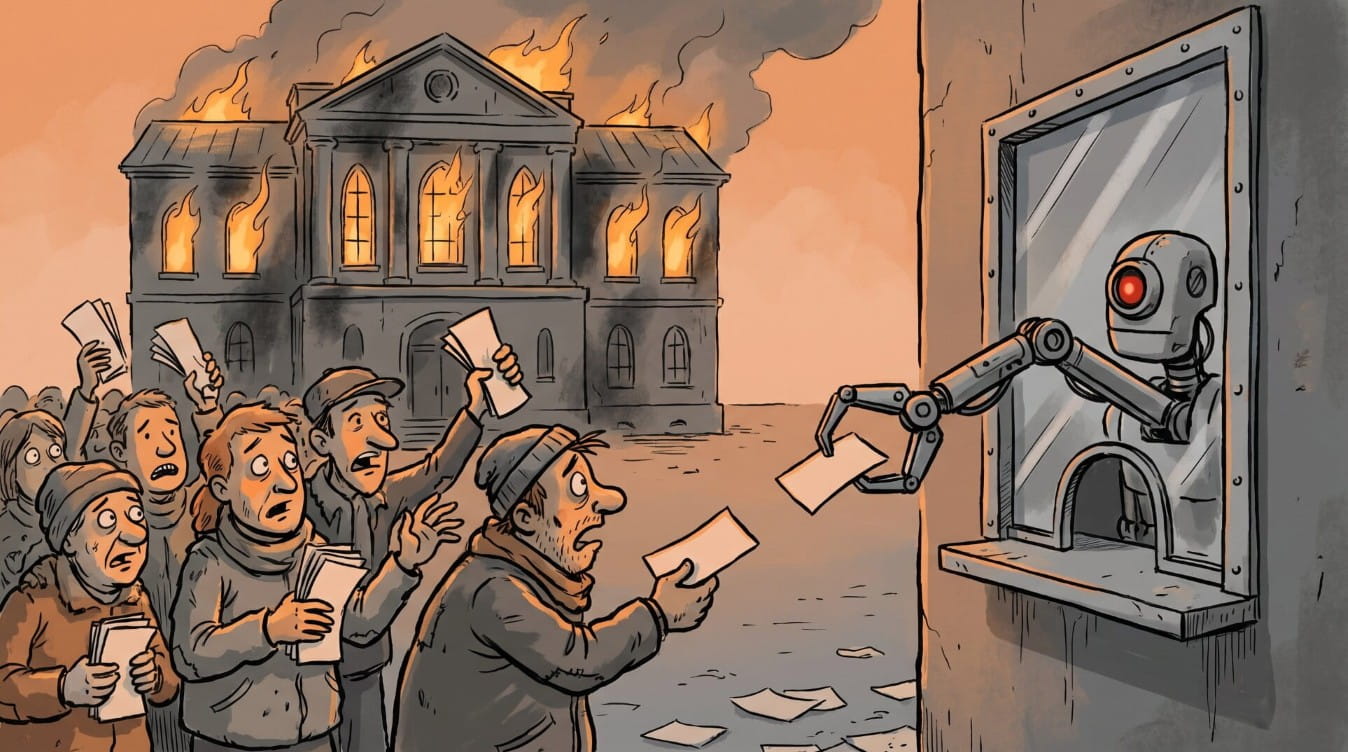
Pattern 6: Customer support failure during crisis events
Tickets receive automated replies. Real-person responses take weeks. Critical issues receive the same handling as cosmetic feature requests. During an actual incident, the venue goes silent or publishes vague reassurance.
- The WazirX July 2024 hack was flagged by an outside security firm before the exchange made any public statement. The exchange took approximately four hours to acknowledge publicly. The subsequent communication shifted from technical specifics to narrative management over the following days.
Support failure during a crisis is not only an operational inconvenience. It is information about how an exchange will behave when user funds are at risk. The question is not whether problems occur. They do at every venue. The question is how fast the venue acknowledges and how transparent the resolution is.
How to check: First of all, check reviews of the exchange on OGAudit and read what crypto OGs say about it. Then open a low-stakes support ticket before depositing significant funds. Time the response from submission to a substantive reply, not the auto-acknowledgment. Search for the venue's public communication during its most recent incident. Was the first acknowledgment internal or from a third party? How long was the gap between the anomaly and the public statement?

Pattern 7: The last-mile problem in crypto theft recovery (MEXC case: John Arokoyo)
In January 2025, a Nigerian trader, John discovered that 389,119 AKA tokens had been drained from his compromised Phantom wallet, swapped into approximately 67.11 SOL and transferred out. Then 66.39 SOL routed toward a MEXC deposit address. The blockchain trail was public, timestamped, and traceable in near real time.
The transaction sequence showed a clear laundering flow:
- Funds were swapped from the victim wallet
- Moved to an attacker-controlled wallet 23 seconds later, consistent with automated drain behavior
- Layered through two intermediary wallets
- Deposited into a MEXC deposit address in five separate transactions totaling 66.39 SOL
The final transfer pattern showed classic fragmentation behavior, with deposits split into 10, 13, 14, 15, and 14.39 SOL over approximately 23 minutes before reaching the exchange deposit address.
Key on-chain evidence:
- Victim wallet: BLFeHgR6PhaU8TjDrsWoaxC29sxwB2YFjuca4LJYrrY2
- Final MEXC deposit address: 8VTb5mqxdoSpuWUxZBZiaTEUpkxdYomZCHBFzGqatfMw
- Initial drain transaction from which anyone can validate the story:
https://solscan.io/tx/5QUT5CuL2sc3QhdjJG46XXU8PxWZW6trUR7tV9rN476D6fyuV1rcmxpcq5y2hgtjWrt7kHdoqRerQmnjBc8sEbJW
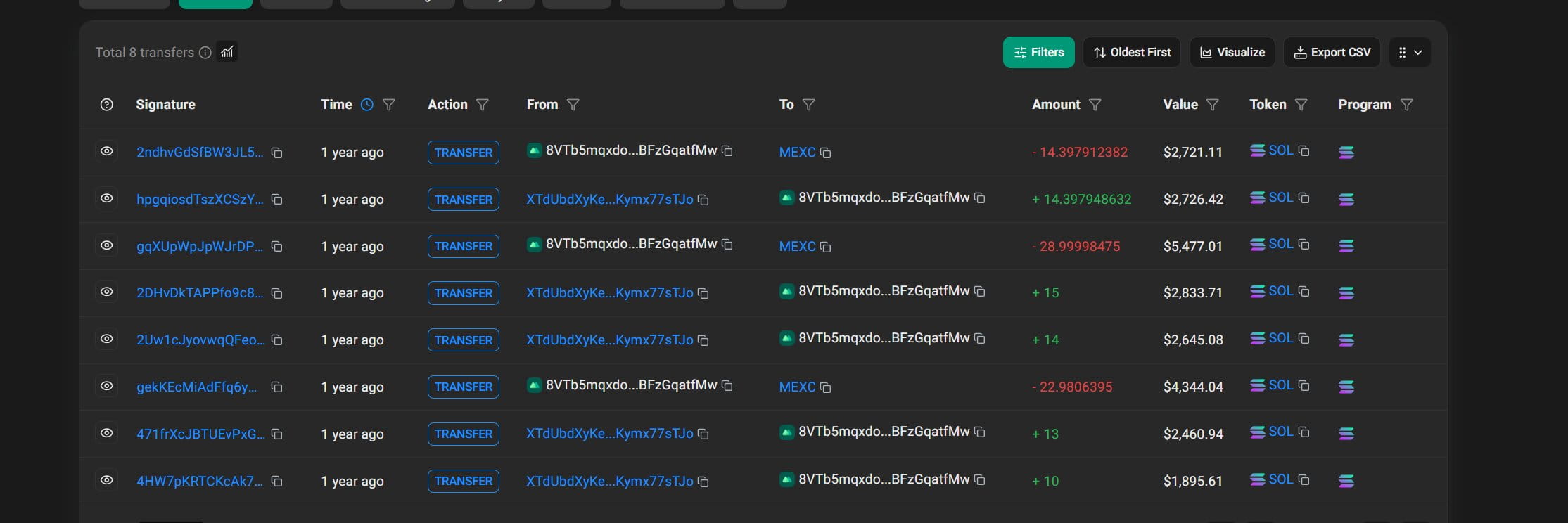
MEXC acknowledged the freeze request and stated that a 48-hour freeze could be extended through law-enforcement follow-up. The victim submitted transaction hashes, wallet data, a police report, two court orders, and later escalated the case to Nigeria’s Economic and Financial Crimes Commission (EFCC) through MEXC’s official legal channels.
According to the documented timeline, MEXC later stated that KYC details could not be disclosed because the account holder was not a Nigerian national. However, support disclosed a partially masked Gmail address linked to the receiving account and told the victim to contact the account holder directly. Law-enforcement follow-ups reportedly continued for months without resolution. Public pressure on X later triggered renewed communication from the exchange after prolonged silence. As of May 2026, funds are still with MEXC.
This case is not evidence of exchange theft. The initial compromise most likely occurred at the wallet level. The structural issue emerged later: the stolen funds were publicly traceable to a known exchange deposit address, law enforcement was involved, and court orders existed, yet recovery still stalled. The failure point was not blockchain transparency. It was dependence on centralized exchange cooperation at the final off-ramp.

Proven early warning signals before a crypto exchange fails
These are the observable signals that appear in clusters before a collapse becomes public. The 2024-2026 cases above showed the same sequence. Proven pre-failure signals are listed below.
- Prolonged withdrawal delays increase across multiple assets, not just one chain.
- Social media complaint volume spikes on X, Reddit, Trustpilot, and Sikayetvar (Xolvie) with new same-week clusters, not background noise or individual cases.
- New hype marketing campaigns, partnership retweets and aggressive yield promotions launch during the stress period, hunting fresh deposits.
- API outages and unscheduled maintenance windows multiply, often timed to market-moving events.
- On-chain outflows from labeled team or exchange wallets accelerate.
- Senior employees publicly depart or update their profiles away from the exchange.
- Communication stops or shifts from specifics to vague reassurance: high demand, new security checks, system upgrade.
A single signal is noise. Three or more in the same week is the cluster that matters. The FTX, WazirX, Celsius, Bitforex hit multiple of these in days.
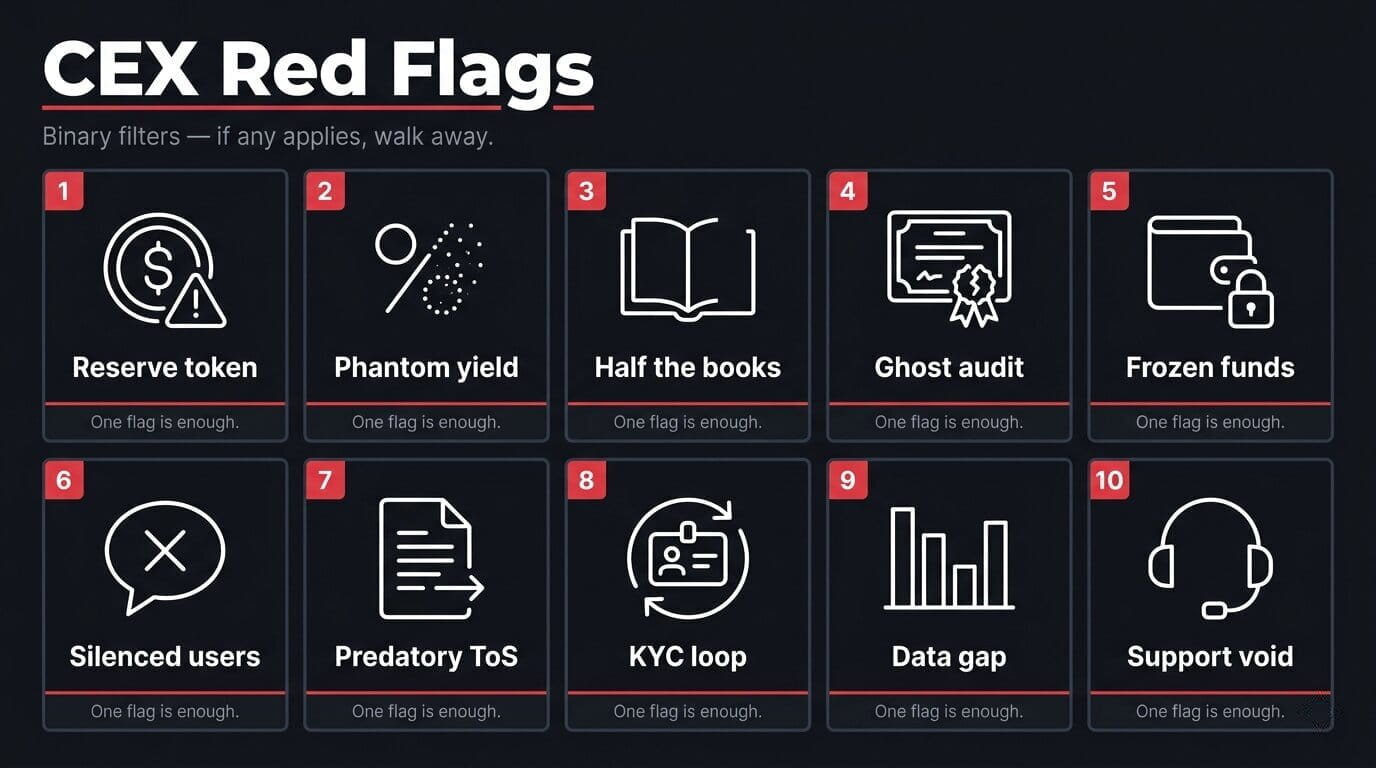
Crypto exchange serious red flags to watch out for
Binary filters. If any of the following applies, no other factor saves the exchange. After personally witnessing the collapse of hundreds of crypto projects and dozens of exchanges over the years, the pattern is always the same. These are the filters that survive every cycle:
- A self-issued exchange token making up more than 50% of reserves (treat anything above 30% with caution).
- Yield products advertising sustained APY above market rates with no disclosed source of yield.
- Proof of Reserves with no liabilities side, worse fail to disclose it at all.
- Audit, license, or insurance claims that cannot be verified at the source.
- Documented history of arbitrary account freezes with no public appeal process.
- Founder or official accounts threaten critics, or moderators ban users for asking about withdrawals or tokenomics.
- Terms of service reserving the right to charge fees on paused or inactive accounts, or to deploy customer assets.
- Repeat KYC requests after initial full verification with no specific deficiency cited.
- Frontend and backend financial data that do not reconcile.
- Non-existent real customer support, a total lack of communication and updates via official channels.
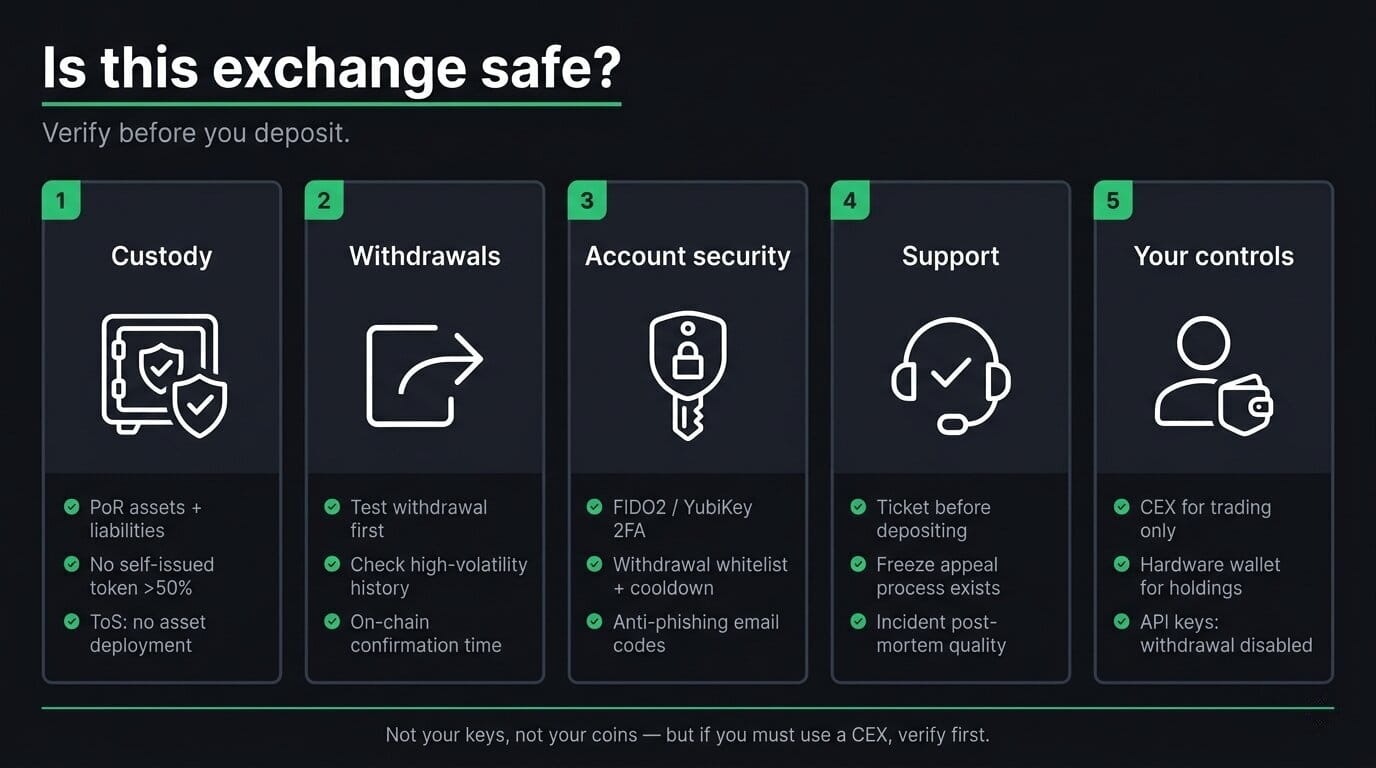
What to verify if an exchange is safe before depositing: a practical checklist
The cases above identify the likely failure modes. These verification steps map to them directly.
Custody and fund safety
✅ Proof of Reserves covers both assets and liabilities. Assets-only PoR is not solvency verification.
✅ Reserve composition: self-issued token concentration above 30% needs scrutiny; above 50% is the FTX/FTT red flag pattern.
✅ Terms of service does not grant the exchange any right to use or deploy customer assets.
✅ Named external auditor with a published report, not just a self-attestation.
✅ Public bug bounty program with disclosed payout history.
Withdrawal reliability
✅ Run a small test withdrawal before depositing significant funds. Time from request to on-chain confirmation.
✅ Check the exchange's behavior during its most recent high-volatility period. Did withdrawals clear normally?
Account security (If your exchange supports these enable ASAP)
✅ Hardware-key 2FA available (FIDO2, YubiKey). SMS-only 2FA is a SIM-swap exposure.
✅ Withdrawal address whitelist with a 24 to 48-hour cooldown on new entries.
✅ Anti-phishing codes on outbound emails.
Support and dispute resolution
✅ Open a low-priority ticket before depositing. Time the substantive response, not the auto-reply.
✅ Documented freeze appeal process with published average resolution times.
✅ Read the most recent incident post-mortem. Was the first acknowledgment from the exchange or from a third party?
Data integrity
✅ If you are going in large, at first run a small trade. Export the trade history CSV. Confirm the fee in the export matches the fee shown at execution. Any gap is a data integrity flag before it becomes a dispute.
User-side controls
- Trade on the CEX whenever possible. Hold long-term on a hardware wallet. Move funds within 48 hours of purchase if not actively trading.
- Unique passwords from a password manager. Credential stuffing is the most common individual account compromise vector.
- API keys: withdrawal-disabled for read-only access, IP-whitelisted for trading bots, rotated on any suspicious activity.
- Bookmark the real URL. Never follow exchange links from email or search engines to avoid phishing attacks.
- Size exposure to any single CEX at active trading needs for the next 15 days, not total holdings.
How OGAudit community rates exchanges: Independent audits by verified Crypto OGs
The cases above represent the kind of operational risk that algorithmic exchange rankings cannot capture. Reported volume, order book spreads at rest, and self-reported security features are all inputs. What the OGAudit community measures is outcomes: whether withdrawals clear under stress, whether incident disclosure is fast and honest, whether fee records match the interface, whether insurance actually pays out when triggered, and most importantly they study and report real and unsolved customer complaints. Many affiliate-driven exchange reviews ignore these signals entirely, as our analysis of misleading crypto exchange reviews shows.
OGAudit's Exchange OG Score is built from independent audits submitted by verified Crypto OGs with EVM wallets of at least 1,000 days of on-chain history. Six operational metrics are scored independently: Usability, Insurance, Fees, Speed, Liquidity, and Security. Reviews are permanent, timestamped, and attributed to an on-chain identity. Nothing is editable after submission. See the full exchange ranking methodology, and also OGAudit Social audit methodology.
As of May 2026, the OG Score covers 46 centralized exchanges across 260+ independent audits from 32 verified Crypto OGs.
The one rule that survives every cycle: "Not your keys, not your coins"
Every case documented above involves funds that were on an exchange when the failure occurred. Bohdan's disputed liquidation happened on a MEXC futures position where he couldn’t add margin and reportedly unfairly liquidated. The 16 million WazirX users whose withdrawals were frozen for 16 months had their funds in custody at the moment of the hack. BitForex users who could not complete KYC watched a monthly fee consume their trapped balance. FTX users faced sudden withdrawal freezes and the collapse of the exchange, losing access to their funds. Many were forced into bankruptcy proceedings as creditors, waiting years for partial asset recovery.
The verification checklist above reduces the probability of choosing the wrong venue. It does not eliminate counterparty risk. The only position with no counterparty risk is self-custody. The closer behavior matches that split, the less any single exchange score matters.
Disclaimer: Always conduct your own research (DYOR) before using any cryptocurrency exchange. This article is based on publicly available court records, official exchange statements, blockchain transaction data, archived announcements, user reports, and external investigative research available as of May 2026. The OG Score and reviewer observations referenced throughout reflect the opinions and experiences of verified Crypto OGs and do not constitute legal, financial, or investment advice. OGAudit does not endorse, guarantee, or approve any exchange or platform.
About the author:
Kripto Raptor is the Chief OG at OGAudit.com and an independent Web3 researcher, blockchain analyst, and entrepreneur. Working full-time in the crypto industry since 2020, he specializes in evaluating Web3 and fintech projects through security analysis, community behavior, and market dynamics. At OGAudit, he publishes data-driven research, crypto social audit reviews, and in-depth project evaluations focused on transparency, risk assessment, and real-world performance. Follow Kripto Raptor on OGAudit, X (Twitter), and LinkedIn.
Frequently Asked Questions about Centralized Exchange Security
What is the most reliable early warning sign of exchange failure?
Withdrawal friction during normal market conditions. Not during a crash, when everyone notices. During quiet weeks, when lengthening processing times, new verification steps, and asset-specific pauses are easy to dismiss as technical issues. These are the early instruments of stress, and they appear in every documented collapse before the announcement.
Does Proof of Reserves confirm solvency?
No. PoR proves the exchange controlled the listed assets at a specific moment. An exchange holding $5B in customer assets against $6B in customer liabilities passes an assets-only PoR and is insolvent. Demand both assets and liabilities, with attestation from a known external auditor.
What is the single biggest mistake when choosing a CEX?
Treating brand visibility as a safety signal. FTX held naming rights to a major sports arena. Celsius ran national television advertisements. Both collapsed within the same year as the marketing campaigns. Marketing spend correlates with customer acquisition ambition, not custody hygiene.
How much capital should be kept on a single CEX?
As little as possible, sized to active trading needs over the next 15 days. The right question is not how much can be held safely on this exchange. It is how little can be held while still executing the intended strategy. Long-term holdings belong in self-custody regardless of how the venue scores.
Is a decentralized exchange safer than a high-scoring CEX?
Different risk model, not strictly safer but safe in most cases if it is audited and battle tested. A DEX removes counterparty risk and adds smart-contract risk, MEV exposure, and self-custody operational risk. For active trading on liquid pairs, a CEX with a high OG Score and positive reviews, with strict withdrawal hygiene is often the right tool. For long-term holding, neither CEX nor DEX is the right venue.
Why do exchanges freeze accounts after a user makes a profit or requests a withdrawal?
Freezes after large gains or withdrawal requests often point to weak onboarding compliance. When an exchange skips proper checks at signup, it may trigger repeated KYC or source-of-funds reviews later, at the moment users try to withdraw. Before depositing, check whether the exchange publishes a freeze appeal process with resolution times.


