
Trending Coins and Tokens🔥


Crypto
Exchange


TL;DR CertiK Skynet, Hacken, CER.live and OGAudit measure different layers of crypto risk. Skynet combines six categories into a dynamic project risk score, Hacken reviews defined technical scopes, CER.live turns visible security evidence into public ratings, and OGAudit adds wallet verified social audits covering team behavior, tokenomics, liquidity, execution, user experience, and community trust. None is a complete safety verdict. Read the audit report, inspect the rating methodology, check verified community evidence, and investigate where the signals disagree.

Why Crypto Ratings Disagree, or Do They?
Most traders trust audit badges the way gamblers trust hot streaks. Not all crypto safety tools are equal, and they were never meant to be. CertiK Skynet, Hacken, CER.live, and OGAudit each answer a different question.
Three platforms can evaluate the same token and still reach different conclusions because their methodologies focus on different layers of risk. Some prioritize code and audit evidence, while others assess broader project health, market structure, governance, or the human and community signals surrounding the coin.
That difference matters because crypto losses rarely stay within one category. A contract can pass an audit while the team still retains dangerous upgrade or liquidity controls. A token can carry a strong public security score while insiders hold toxic unlock power. A project can look active on social media while users who ask hard questions are quietly removed.
The useful question is not which crypto rating is best. It is what the rating measures, what it misses, and what disagreement between systems tells you. A score is not the answer. It is a map of what the methodology could see.
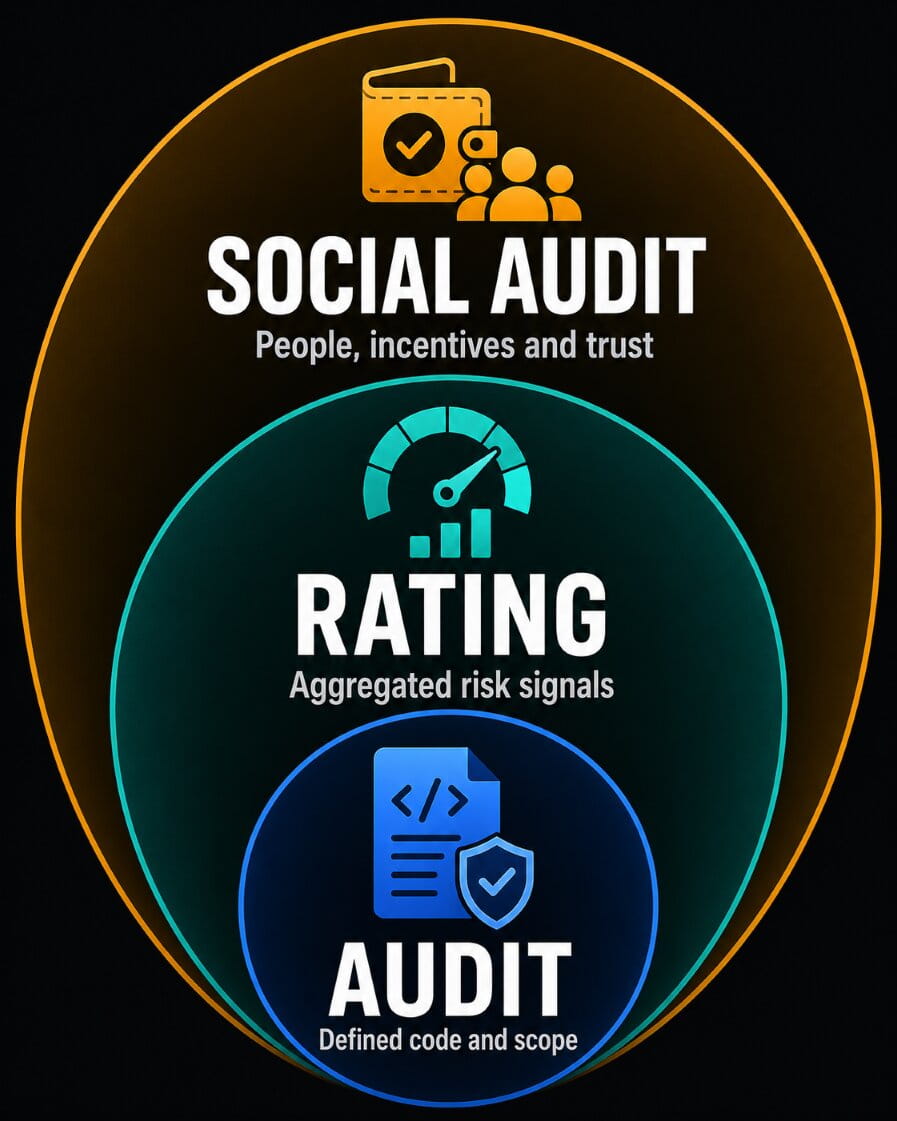
Audit, Rating, Social Audit: Clean Definitions
A smart contract audit is a point in time technical review of a defined codebase. It produces findings, severity labels, remediation notes, and scope boundaries. It answers one main question: was this specific code reviewed against known vulnerability classes?
A rating is an aggregated score or grade across several signals. It may update as new evidence appears. It answers a different question: how does this project look compared with peers under a defined methodology?
A social audit, also known as a community review, is a structured assessment of trust signals by experienced users. It asks a different question: what do verified reviewers observe when evaluating the people, tokenomics, liquidity, community behavior, and execution surrounding a coin? Unlike a point in time assessment, a social audit develops as new community reviews arrive, helping readers track the project’s progress, emerging risks, and changes in overall trust over time.
These three layers are not competitors by default. Code can be clean while incentives are toxic. Community can be strong while code is weak. Ratings can be high while the most important risk sits outside the methodology.
What Each System Actually Measures
CertiK Skynet: Broad Coverage, Bounded Proof
CertiK Skynet is a public risk monitoring and rating system for Web3 projects. CertiK also provides paid smart contract audit services, while Skynet is a separate public monitoring product. Its published methodology assigns a score from 0 to 100 across six core categories: Code Security, Fundamental Health, Operational Resilience, Governance Strength, Market Dynamic, and Community Trust.
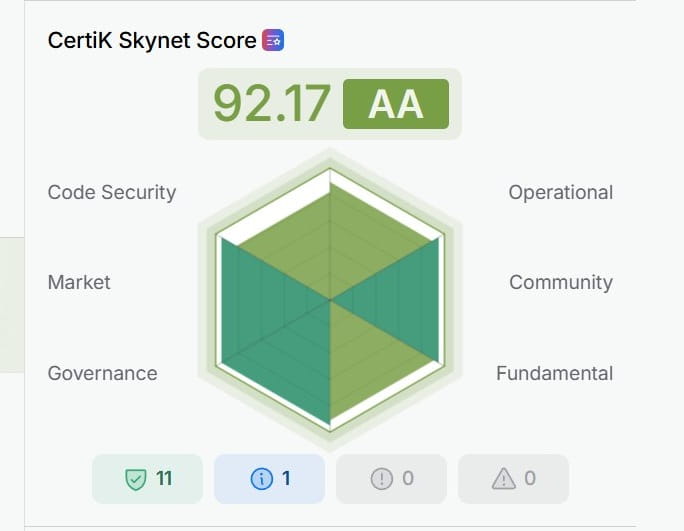
Skynet’s main strength is its broad coverage. A reader can look beyond a simple audit badge and inspect category level signals. That matters because a single number can hide the weak part of a project. A strong total score can still contain a category that deserves deeper review.
The Community Trust category should also be read carefully. CertiK says it incorporates social audience size, posting activity, sentiment, and engagement from platforms such as X, Telegram, and Discord, alongside interactions on CertiK’s own platform.
These indicators can measure visibility and communication activity, but they are not the same as verified community trust. Followers, sentiment, votes, and engagement can be inflated through bots, paid activity, or coordinated campaigns, so a strong community score should not be treated as proof of an authentic or independent user base.
The main risk is overreading the score. A high Skynet rating does not prove that the team will never abuse an admin key, that the project has a working product, or that the token has a meaningful use case within the ecosystem. Nor does it guarantee that insiders will not dump into liquidity or that moderators will allow open discussion of vesting concerns.
Skynet builds its score from observable data and raw signals available to its methodology, but those inputs cannot fully capture product quality, human behavior, or intent.
That does not make CertiK useless. It makes scope discipline necessary. Use CertiK for the layer it was built to inspect. Then compare it with other layers. A serious researcher does not worship a single dashboard. They read the breakdown, check the evidence, and ask what sits outside the methodology.
Hacken and CER.live: Technical Evidence, Not Final Verdicts
Hacken and CER.live sit mainly within the technical security layer. Hacken provides smart contract audits and related security services, while CER.live publishes public security ratings using defined indicators. They are different products with related use cases: Hacken reviews a defined technical scope, while CER.live turns available security evidence into a public rating.
A Hacken audit is a point in time technical review of the code included within its defined scope. Its smart contract audit methodology combines structured scoping, manual analysis, testing, reporting, and remediation checks. This can provide useful evidence about known vulnerabilities, but it should not be treated as a permanent safety certificate or proof that the project itself is trustworthy.
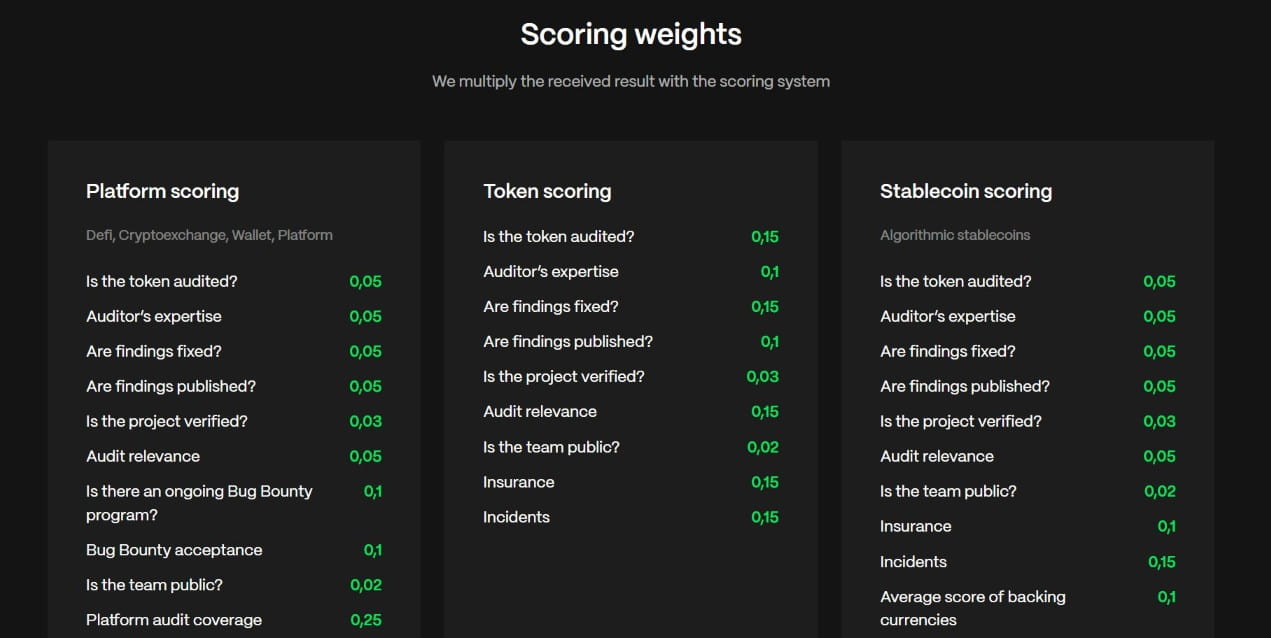
CER.live evaluates visible security indicators rather than directly judging the full quality of a project. Its cryptocurrency rating methodology considers factors such as whether a token has been audited, the auditor’s experience, whether findings were fixed and published, project verification, audit relevance, public team information, insurance, and previous incidents. These signals help organize technical evidence, but the score remains limited by the quality, relevance, and freshness of the available inputs.
Hacken and CER.live are therefore best read as complementary parts of the technical security layer, not as competing answers to every form of crypto risk. Both can provide useful evidence, but neither replaces social audit work.
They do not fully assess whether a project has a sustainable revenue model, meaningful token utility, fair incentives, responsible unlock design, healthy liquidity, or an authentic community. These are precisely the areas where verified user experience, repeated behavioral signals, and long term community observation become necessary.
OGAudit: The Layer Audit Badges Cannot Reach
OGAudit sits on the crypto social audit and trust intelligence layer. It does not try to replace code auditors. Instead, it evaluates risks that audit badges and automated security dashboards often miss: team identity and prior behavior, whether the project solves a real problem, the token’s actual role and utility, token distribution, unlock pressure, liquidity integrity, community credibility, reviewer consensus, and the accuracy of public claims.
For coin and token pages, OGAudit helps answer one practical question: would an experienced crypto user trust this project after examining the human, economic, and social signals surrounding it? For centralized exchanges, the Exchange OG Score methodology focuses on usability, insurance, fees, withdrawal speed, liquidity, and security. Both are different from asking whether a contract was audited or whether a platform has a high public security score. One layer can look strong while another still fails.
Crypto is crowded with short lived projects that raise funds on weak promises, deliver little, and disappear once attention or liquidity dries up.
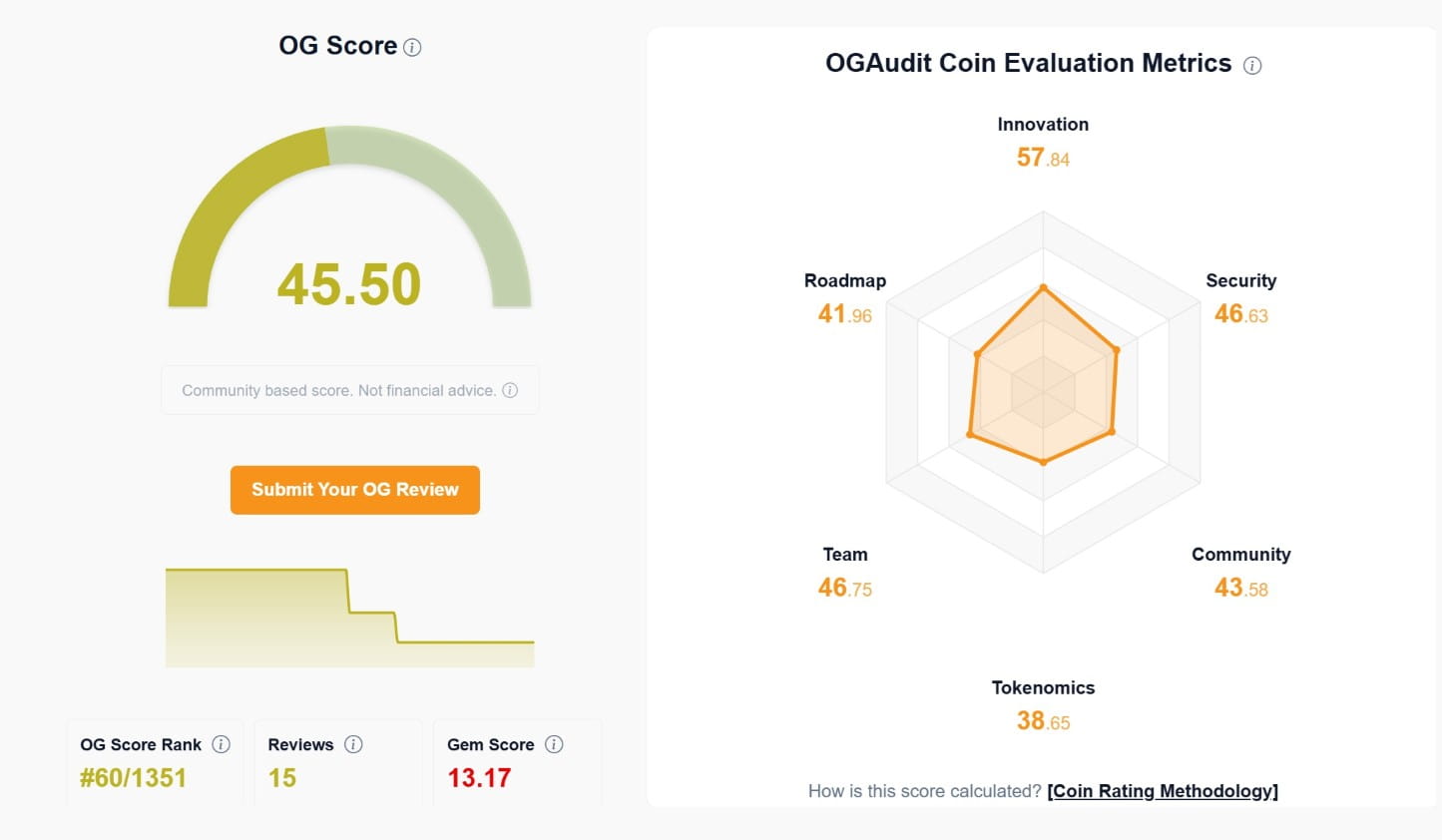
OGAudit uses wallet verified reviewers, at least 1,000 days of verifiable EVM wallet history, permanent reviews, price stamped review context, and enforced community guidelines to make fake review manipulation more difficult.
The OG Score methodology for coins explains how reviewer evidence and consensus are converted into a public trust rating. The goal is not blind trust in community opinion, but a reviewer layer that is harder to game than a normal comment section, influencer thread, or generic star rating.
OGAudit does not score code, and that boundary should remain clear. A smart contract audit examines the contract. A community audit examines what the contract cannot reveal by itself: the people behind the token, the incentives they created, the liquidity they control, the project’s real progress, and how the community behaves when difficult questions arise.
It is not a perfect system, but it provides a trust signal the crypto market badly needs. Learn more about OGAudit and its reviewer model.
Methodology Comparison
CertiK Skynet
-
Measures: The risk profile of Web3 projects across code security, fundamentals, operations, governance, market activity, and community signals
- Best for: Broad, continuously updated project monitoring and identifying which risk categories require closer inspection
- Main limitation: Its score is built from observable on chain and off chain indicators. These signals can organize available evidence, but they cannot fully establish product quality, insider behavior, or intent
Hacken and CER.live
- Measures: Hacken reviews defined technical scopes through services such as smart contract audits, tokenomics reviews, penetration testing, and proof of reserves. CER.live converts visible security indicators into public ratings for coins, tokens, exchanges, and wallets
- Best for: Reviewing technical security evidence, audit findings, remediation status, security controls, and whether available evidence remains relevant
- Main limitation: These outputs primarily assess technical and documented security evidence. They do not replace long term observation of team behavior, project execution, community credibility, user experience, or changing incentives
OGAudit
-
Measures: Social trust and real world risk signals around coins, token projects, and centralized exchanges, including team behavior, utility, tokenomics, liquidity, community credibility, user experience, and reviewer consensus
- Best for: Identifying human, economic, operational, and community risks that code reviews and automated dashboards may not capture
- Main limitation: OGAudit does not independently audit source code. However, verified reviewers can examine existing audit reports, unresolved findings, remediation evidence, and incident history as part of a broader community assessment. Small review samples should still be interpreted cautiously
Quick Comparison
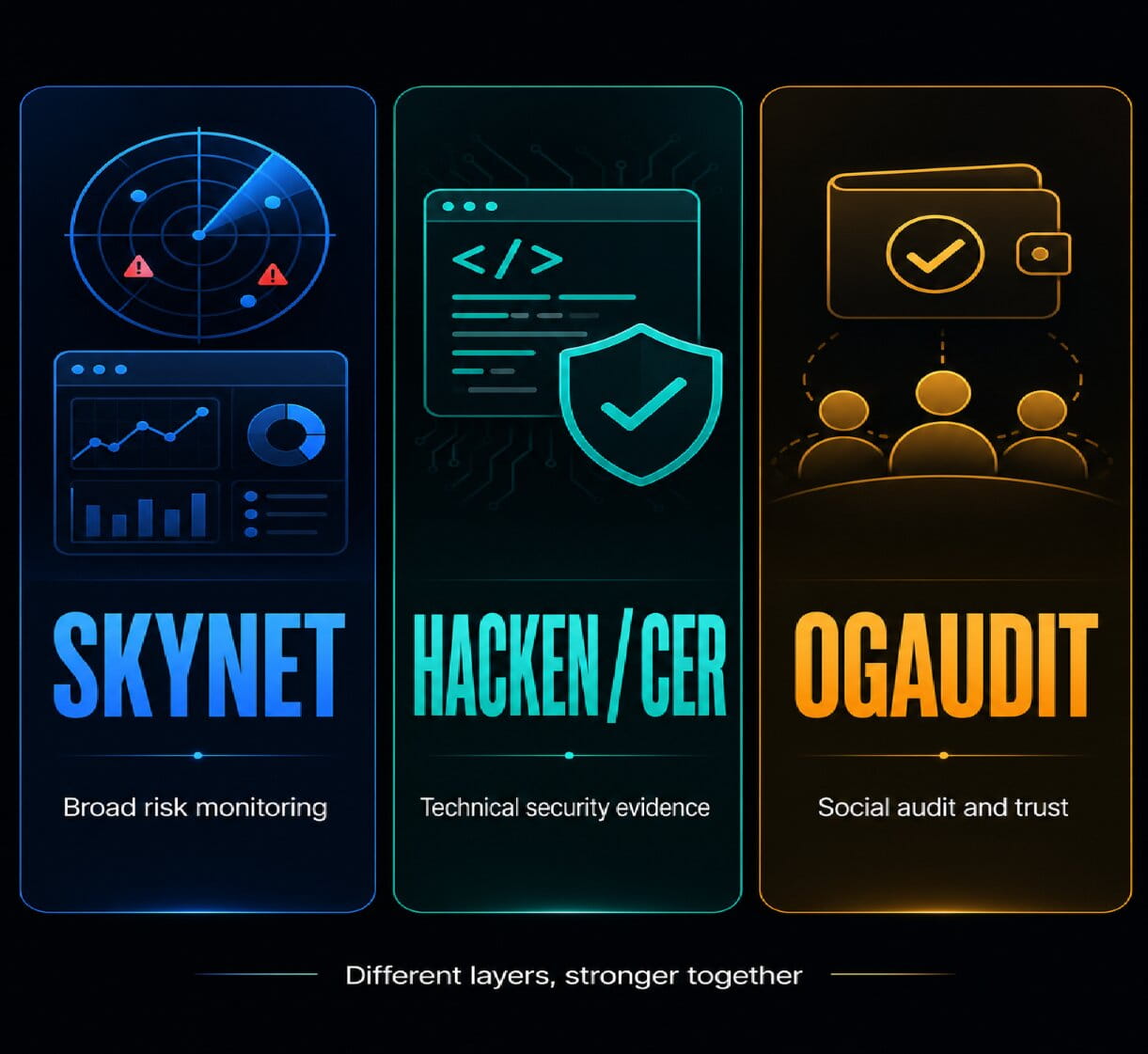
- CertiK Skynet: Broad and dynamic project risk monitoring
- Hacken and CER.live: Technical reviews and structured security evidence
- OGAudit: Verified social audits of crypto projects and exchanges
None of these systems is a universal winner. CertiK Skynet provides a broad risk snapshot, Hacken and CER.live organize technical and documented security evidence, while OGAudit evaluates how projects and exchanges perform across the human, economic, operational, and community layers. Strong due diligence combines these signals and investigates where they disagree.
When Technical Ratings and Community Audits Disagree
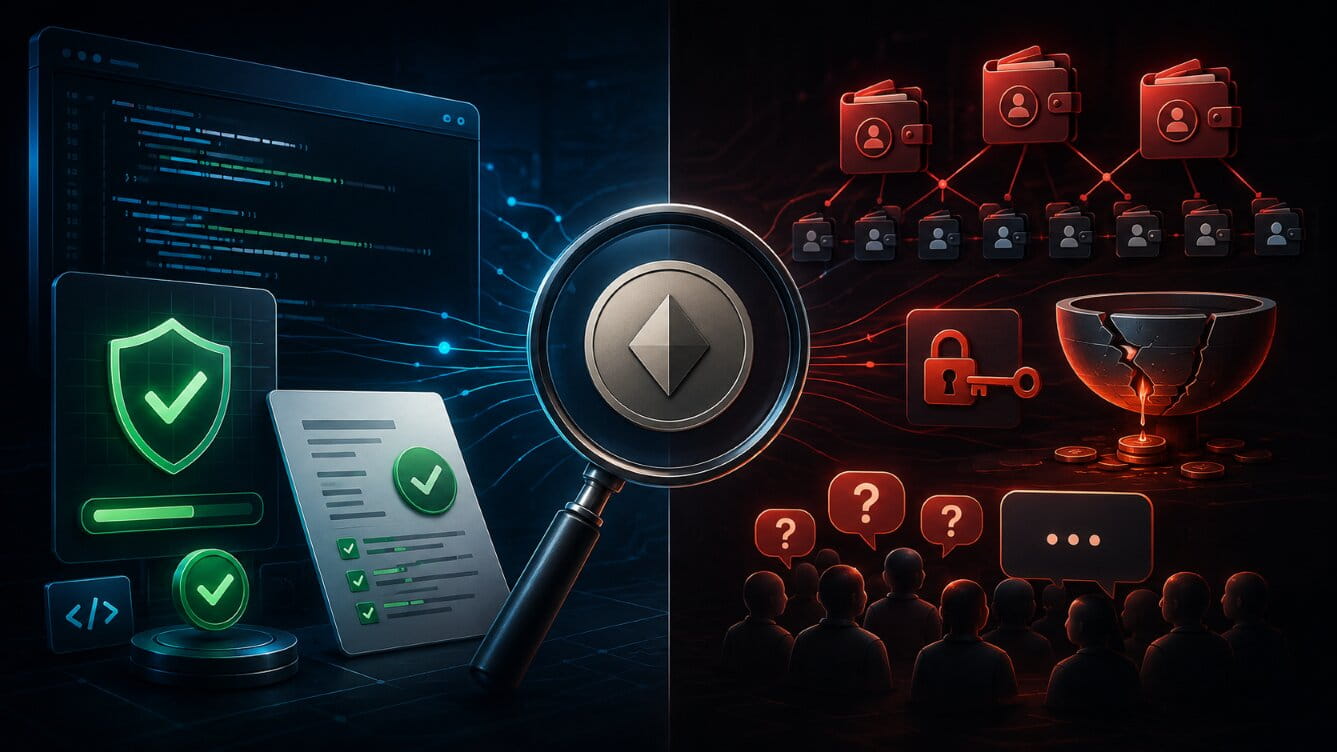
A CertiK Skynet score, a Hacken audit, a CER.live rating, and an OGAudit community audit can produce different conclusions about the same project. This does not automatically mean that one system is wrong. More often, the disagreement reflects a difference in what each methodology measures.
Technical audits examine a defined codebase and security scope. Public ratings organize available technical, operational, market, and project data. Community audits assess how those findings compare with team behavior, token incentives, liquidity control, public accountability, project execution, and the experience of verified users.
A project may therefore show strong technical evidence while raising serious concerns at the human or economic layer. The reverse is also possible. A loyal community and positive sentiment cannot compensate for unresolved vulnerabilities, outdated audit coverage, or dangerous privileged roles.
How to Interpret the Disagreement
This is not a new score, formula, or OGAudit metric. It is a practical way to interpret disagreement between technical evidence and community trust.
- Strong technical evidence, weak community trust: Investigate team behavior, privileged controls, token distribution, unlocks, liquidity custody, public disclosure, and the treatment of difficult questions.
- Weak technical evidence, strong community trust: Community support does not remove unresolved code risk, missing audit coverage, or unverified security claims.
- Strong evidence across both layers: Confidence improves, but contract upgrades, governance changes, liquidity movements, token unlocks, and new incidents still require monitoring.
- Insufficient evidence across both layers: No reliable conclusion can be reached. Missing information is not a bullish or bearish signal.
- Strong hype, weak independent evidence: Attention measures visibility, not trust. Followers, engagement, and promotional activity should not be mistaken for verified adoption or credible community consensus.
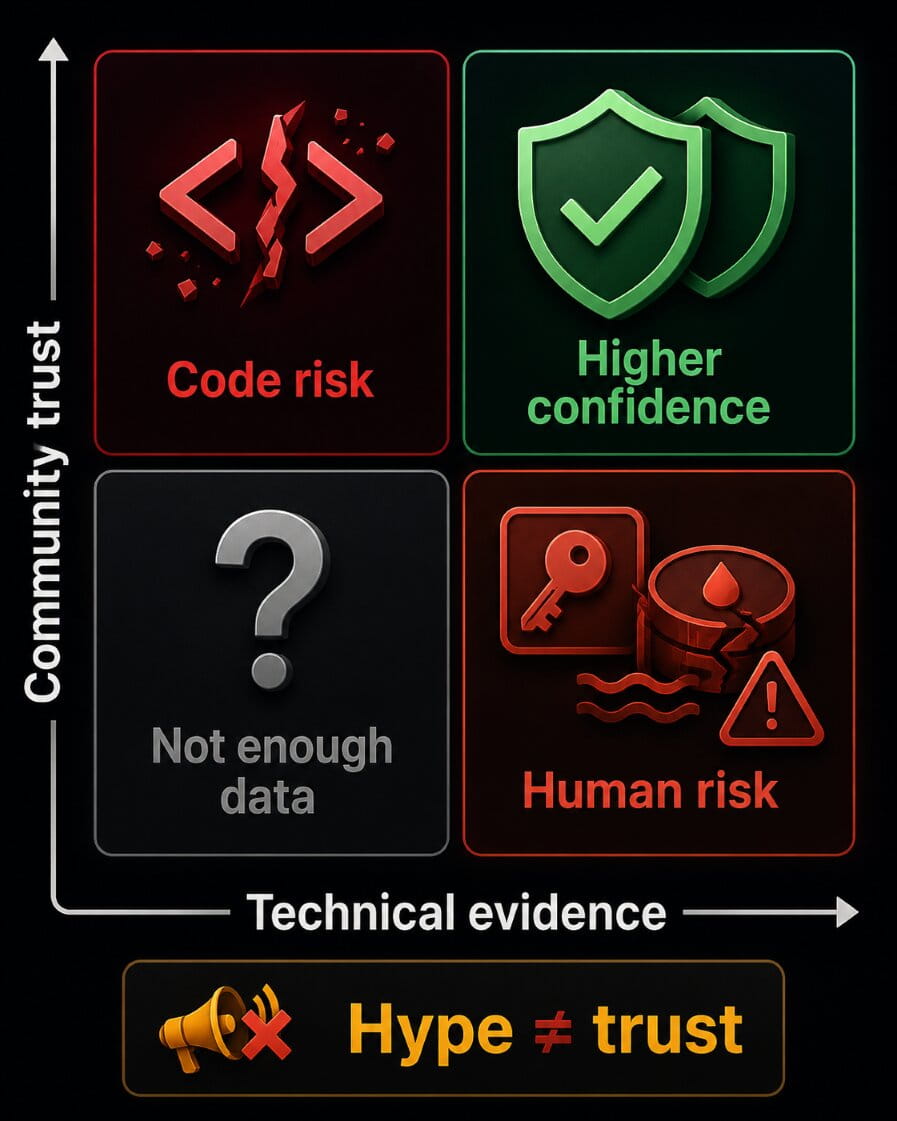
The purpose of comparing these layers is not to declare a universal winner. Agreement across independent sources can strengthen confidence, while disagreement shows where further investigation is required. A rating gap should produce better questions, not an automatic verdict.
Why Audited Crypto Projects Can Still Fail: Swaprum and Merlin
Smart contract audits provide valuable technical evidence, but an audit badge can create more confidence than the underlying report supports. Swaprum and Merlin show two different ways an audited crypto project can still expose users to serious losses.
These cases do not prove that every audit is ineffective. They show the limits of audit based assurance when dangerous privileges remain active, users do not understand the scope of the review, or the audited implementation can later be replaced by the same people controlling user funds.
Swaprum: Audited Code, Malicious Upgrade
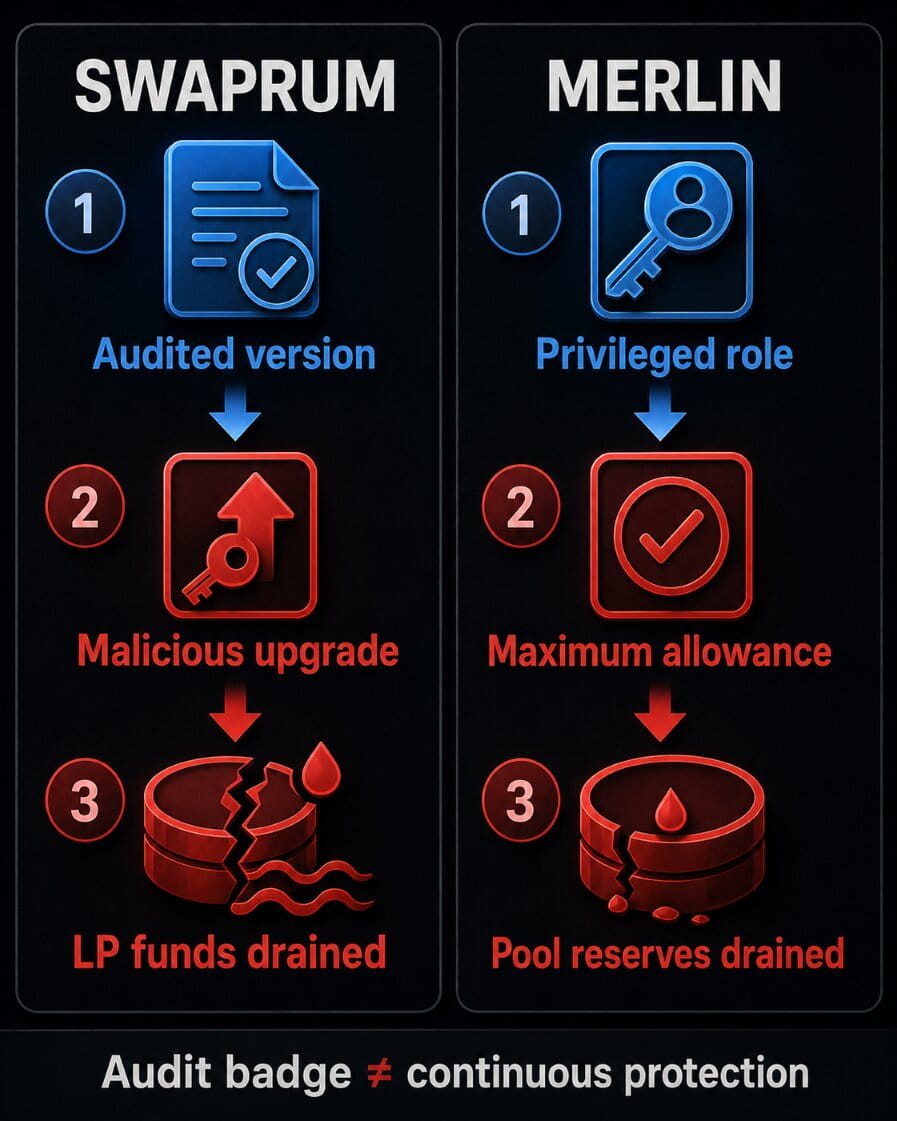
Swaprum was an Arbitrum based DeFi protocol with decentralized exchange and staking contracts. CertiK published its audit report on May 5, 2023. Less than two weeks later, on May 18, the project owner upgraded the MasterChef staking contract to a malicious implementation.
According to CertiK’s later incident analysis, the new implementation differed from the audited version. It allowed staked LP tokens to be moved, liquidity to be removed, and additional Swaprum tokens to be minted for the deployer. CertiK recorded a loss of approximately $3 million and classified the incident as outside the audit scope.
Cointelegraph, citing PeckShield, reported that roughly 1,628 ETH was removed from Swaprum’s liquidity pools, bridged to Ethereum, and largely transferred through Tornado Cash. The project’s X, Telegram, and GitHub accounts were also deleted after the incident.
The failure was not simply an overlooked software bug. The deeper problem was that users were shown an audit badge while the project owner retained the power to replace the reviewed implementation with malicious code. The audit described one version of the system, but it could not provide continuing protection against the person controlling the upgrade path.
For users, the distinction offered little protection. Audit coverage created confidence, while the project’s control structure remained capable of defeating that assurance after funds had been deposited.
A broader crypto due diligence review would have asked who controlled upgrades, whether changes required a timelock or independent multisig, who controlled liquidity, whether privileged actions were monitored, and whether the team could be held accountable. These are not secondary details. They determine whether audited code can remain trustworthy after deployment.
Merlin: A Privileged Role Vulnerability Within Audit Scope
Merlin DEX presents a more direct failure. CertiK’s audit report was published on April 14, 2023. On April 26, Merlin’s liquidity pools were drained of 435 WETH and 811,000 USDC, a loss valued at more than $1.82 million at the time, according to CertiK’s incident postmortem.
CertiK’s technical analysis identified a vulnerability in the initialization of the MerlinSwapPair contract. Maximum token allowances were granted to the factory contract’s feeTo role, allowing that address to withdraw all reserves held in the pools.
CertiK’s postmortem also states that this vulnerability was within its audit scope.
Merlin therefore raises a harder question than Swaprum. The dangerous privilege was not introduced only through a later contract upgrade. An address already had the ability to withdraw pool reserves, the vulnerability fell within the reviewed scope, and the control remained active when users supplied liquidity.
An issue being somewhere within an audit scope is not enough if the risk remains live and the project continues to present itself through a simple “audited” label. Users need to know whether the privilege was clearly identified, how seriously it was classified, whether it was removed or restricted, and what practical risk it created for deposited funds.
A serious due diligence process should ask who can move funds, who can upgrade contracts, whether those powers were identified in the audit, whether recommended changes were implemented, and whether the deployed contracts still match the reviewed version. The existence of an audit is the beginning of that process, not its conclusion. For seven more warning signs that audit badges miss, see why smart contract audits fail.
Why the Social Audit Layer Matters
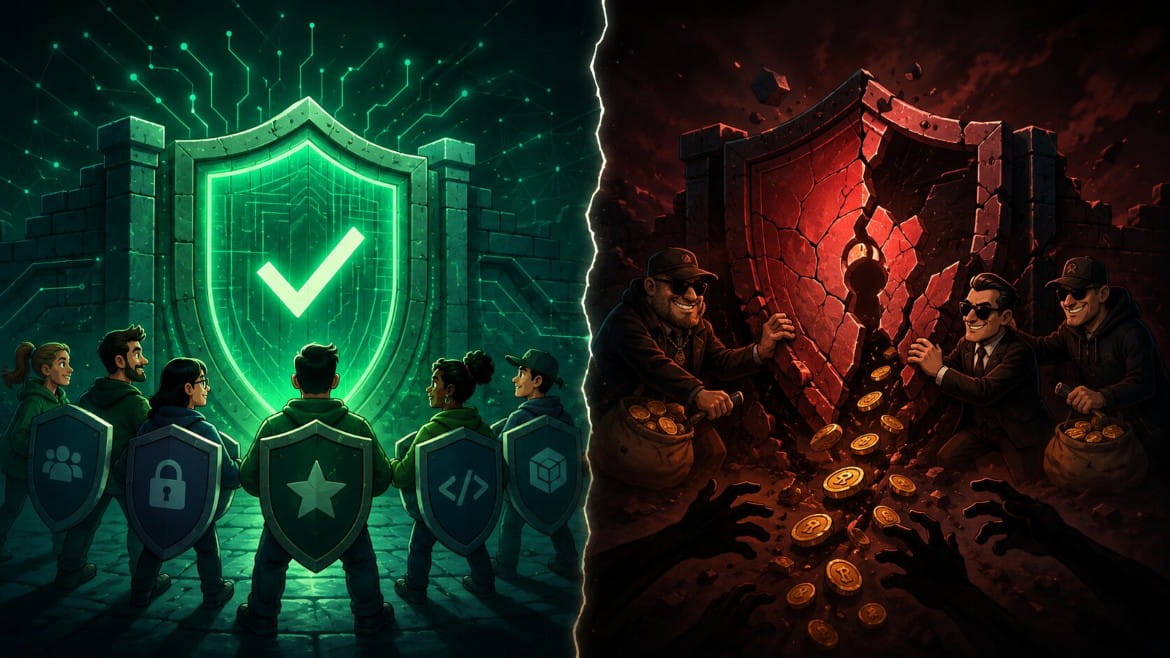
Swaprum and Merlin exposed different weaknesses, but the common lesson is clear: technical evidence alone did not provide users with a complete picture of the risk.
A social audit adds scrutiny around the people, controls, incentives, and behavior surrounding the code. Verified reviewers can examine existing audit reports, unresolved findings, remediation evidence, upgrade authority, team identity, liquidity custody, previous project history, public disclosures, and the way a project responds when difficult questions are raised.
This does not mean that a community audit could have guaranteed prevention, nor does it replace technical analysis. It means that audit findings should be interpreted alongside the people who control the contracts and the incentives guiding their decisions.
The role of the social audit layer is to stop “audited” from being misread as “safe.”
Technical Audit and Rating Blind Spots That Slip Past Most Investors
Scope and live deployment
A smart contract audit reviews a defined codebase and scope. It may not cover every contract, upgrade path, multisig arrangement, front end component, treasury action, or future deployment.
Readers should check the audited commit, contract addresses, covered components, unresolved findings, and whether the live implementation still matches the reviewed code. Swaprum demonstrates why this matters: reviewing one implementation offered little protection after the project owner replaced it with malicious code.
Time and subsequent changes
An audit is a point in time assessment. Code can change, ownership can move, signers can rotate, and governance can introduce new risks. Privileged roles that appear acceptable at launch may later be abused.
The more a system changes after its audit, the less confidence the original badge provides without updated verification.
The audit badge effect
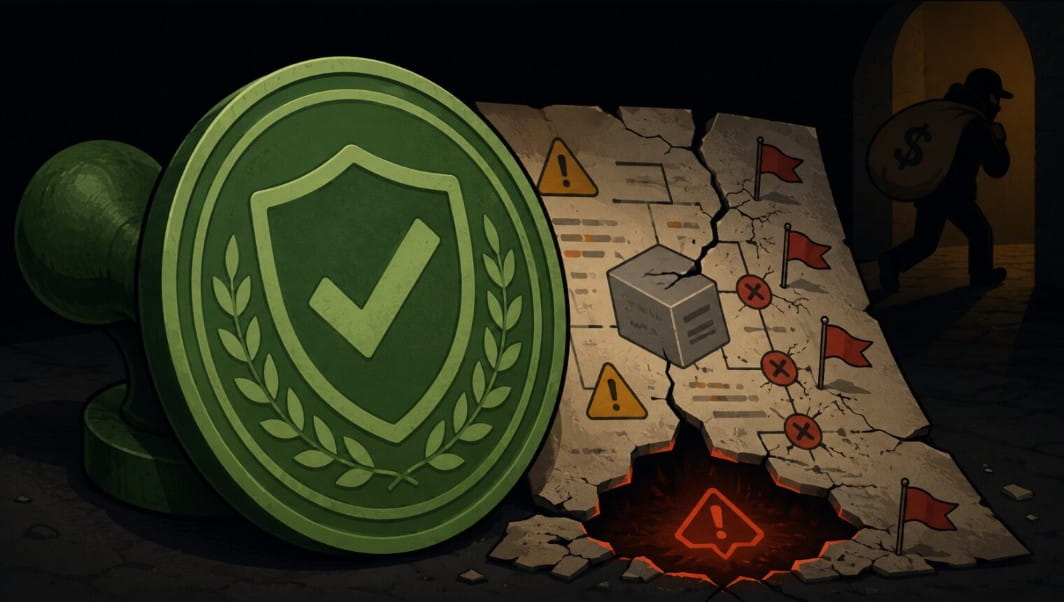
Many users see the word “audited” and stop reading. A serious researcher examines the report itself, including its scope, severity levels, unresolved findings, remediation status, privileged roles, commit hashes, deployed addresses, and stated limitations.
The badge is the wrapper. The report is the evidence. Neither is a guarantee.
Available and submitted evidence
Public security ratings can only assess the information they collect, receive, and verify. Project documents may be incomplete, outdated, or selectively presented. On chain and off chain indicators can add useful context, but observable data does not always reveal the quality of internal controls or the intentions of the people operating them.
A transparent methodology can still produce an incomplete picture when its inputs are weak, stale, or limited.
Community Audit Blind Spots
Sample size and maturity
Community consensus becomes more reliable when several independent reviewers identify the same specific pattern. Five reviews do not carry the same evidentiary weight as a larger and more mature sample.
A small but well supported sample can still provide useful early signals, but it should not be presented as settled consensus. Review counts and evidence quality must remain visible.
Reviewer bias
Users who lost money may judge a project more harshly, while early investors who profited may overlook serious weaknesses. Readers should examine reviewer history, wallet age, reasoning quality, supporting evidence, and whether the same concern appears independently across multiple reviews.
A score becomes less useful when separated from the reasoning behind it.
Manipulation and brigading
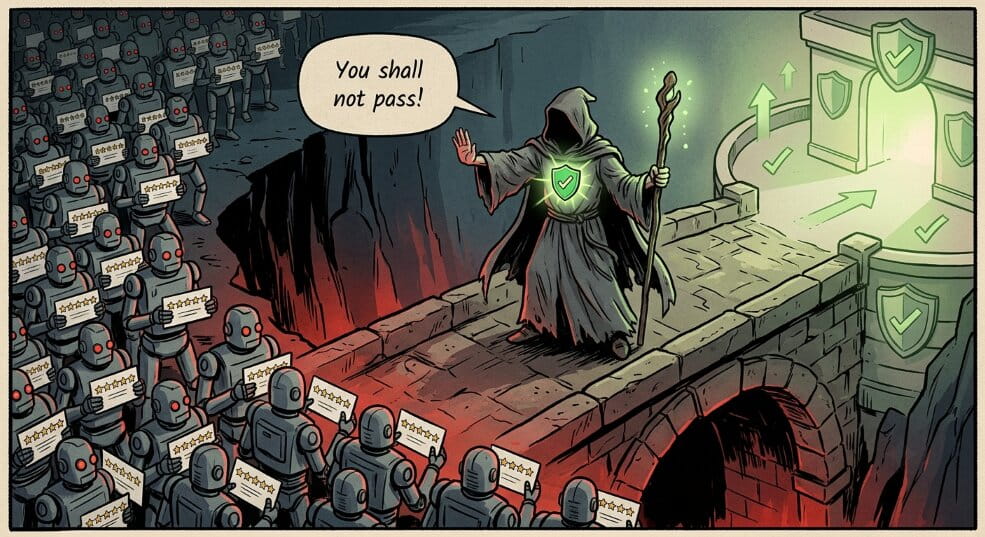
No community system can reduce manipulation risk to zero, but the gap between platforms is significant. Most open review systems rely on anonymous accounts, unverified identities, and removable content, making coordinated manipulation cheap and difficult to detect.
OGAudit's model raises that cost substantially. A 1,000-day minimum EVM wallet requirement, wallet-verified reviewer identities, immutable review history, strict methodology enforcement, and active community guidelines create multiple layers of friction that anonymous brigading and paid sentiment campaigns cannot easily bypass.
The objective is not to claim perfect resistance. It is to make fake consensus substantially harder to manufacture than it would be through anonymous comments, purchased social engagement, influencer promotion, or generic star ratings. On that measure, OGAudit’s structure is significantly harder to manipulate than open review platforms.
We explain these reviewer safeguards, evidence standards, and enforcement rules in our OG Score methodology for coins, our terms, and our community guidelines.
Technical boundaries
OGAudit community does not independently audit source code. However, its verified reviewers may examine existing audit reports, unresolved findings, remediation records, incident history, privileged controls, and deployed contract evidence as part of a broader community assessment.
This remains different from conducting a new technical audit of the codebase. The two layers complement each other. Technical auditors inspect code and defined controls. Community auditors evaluate what those findings mean when combined with team behavior, incentives, liquidity, execution, and public accountability.
Early project uncertainty
New projects often have limited operating history, thin liquidity, incomplete documentation, and small communities. In these cases, insufficient evidence should remain insufficient evidence.
A lack of negative information is not proof of safety, just as early enthusiasm is not proof of long term trust.
The Incentive Problem Behind Every Crypto Rating
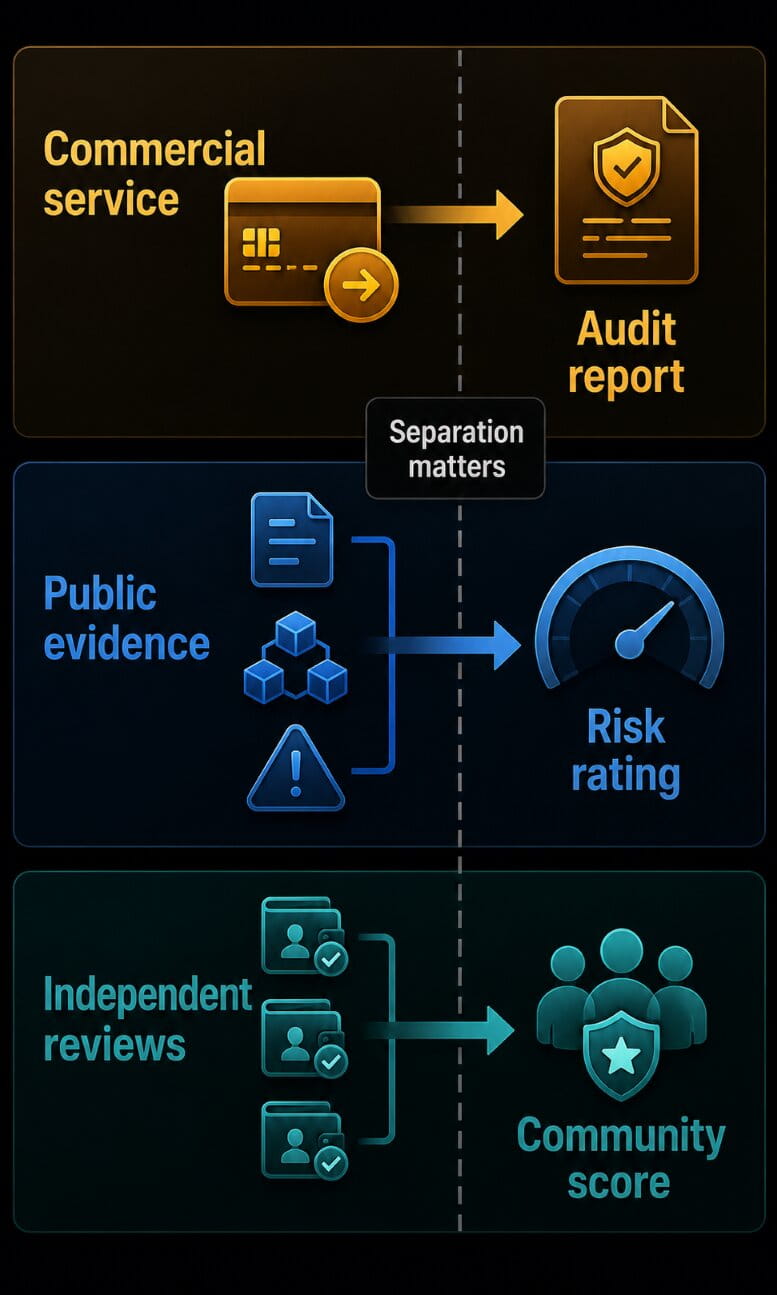
Methodology is only part of a rating system. Readers should also understand who produces the evidence, who pays for the underlying services, how that evidence enters a score, and whether the subject of a review can influence the final result.
A commercial relationship does not automatically invalidate an audit or rating. It does, however, make transparency and separation of roles essential.
CertiK
CertiK provides smart contract audit services and also operates the Skynet rating system. Skynet is broader than a paid audit report and combines multiple on chain and off chain signals across code security, fundamentals, operations, governance, market activity, and community trust, as described in the Skynet Score methodology.
Its Code Security module nevertheless incorporates audit related evidence. This includes available audit reports, finding severity, remediation status, audit coverage, and audit freshness. CertiK can therefore act as a project’s auditor while also operating a public rating system that uses audit evidence within its broader assessment.
This does not prove that a Skynet score can be purchased or that audit clients automatically receive favorable ratings. It means readers should distinguish between the commercial audit engagement, the public Skynet score, the underlying evidence, and the way a project uses both in its marketing.
Hacken and CER.live
Hacken provides smart contract audits and other security services. Its company history identifies CER.live as a platform launched within the Hacken ecosystem in 2018. CER.live now publishes security ratings for coins and tokens, exchanges, wallets, and other crypto platforms.
For coin and token ratings, the CER.live methodology considers factors such as audit status, auditor experience, whether findings were fixed and published, project verification, audit relevance, public team information, insurance, and incident history. It applies additional indicators to certain project types. Platform assessments, for example, may include bug bounty programs and broader audit coverage, while exchange certification considers penetration testing, proof of reserves, and bug bounty evidence.
These are relevant security indicators, but readers should still ask who produced or submitted the evidence, whether the project paid for any underlying assessment, how current the evidence is, and whether the rating can be independently verified.
The relationship between paid security services and a public rating does not automatically invalidate either output. It should simply remain visible rather than being hidden behind a single score or badge.
OGAudit
OGAudit follows a different incentive structure. Under its coin trust rating methodology and exchange rating methodology, reviewed projects and exchanges cannot pay to increase an OG Score, alter or remove reviews, change editorial conclusions, or purchase a better ranking. Advertising and promotional placements, where permitted, must remain clearly labeled and separate from the review and scoring process.
This structure does not remove every possible conflict. Reviewer bias, community politics, thin samples, and coordinated sentiment remain risks. OGAudit addresses them through wallet verified reviewer eligibility, immutable review history, community guidelines, review quality controls, visible supporting evidence, editor notes, and a transparent methodology.
OGAudit’s reviewer standards, scoring rules, and platform mission should remain public and easy to inspect. The About OGAudit page provides the broader context for that model.
No rating system is free from structural limitations or incentives. The relevant standard is inspectability. Readers should be able to identify what is being measured, who produced the evidence, where commercial relationships exist, and which parts of the final result cannot be bought. The same incentive problem affects crypto exchange reviews, where affiliate commissions often shape the rankings.
How to Combine Crypto Ratings Without Getting Fooled
A good crypto researcher does not rely on one score to make the entire decision. The safer approach is to combine several layers of evidence: read the technical audit, understand how the public rating was built, examine the social audit, and investigate any disagreement between them.
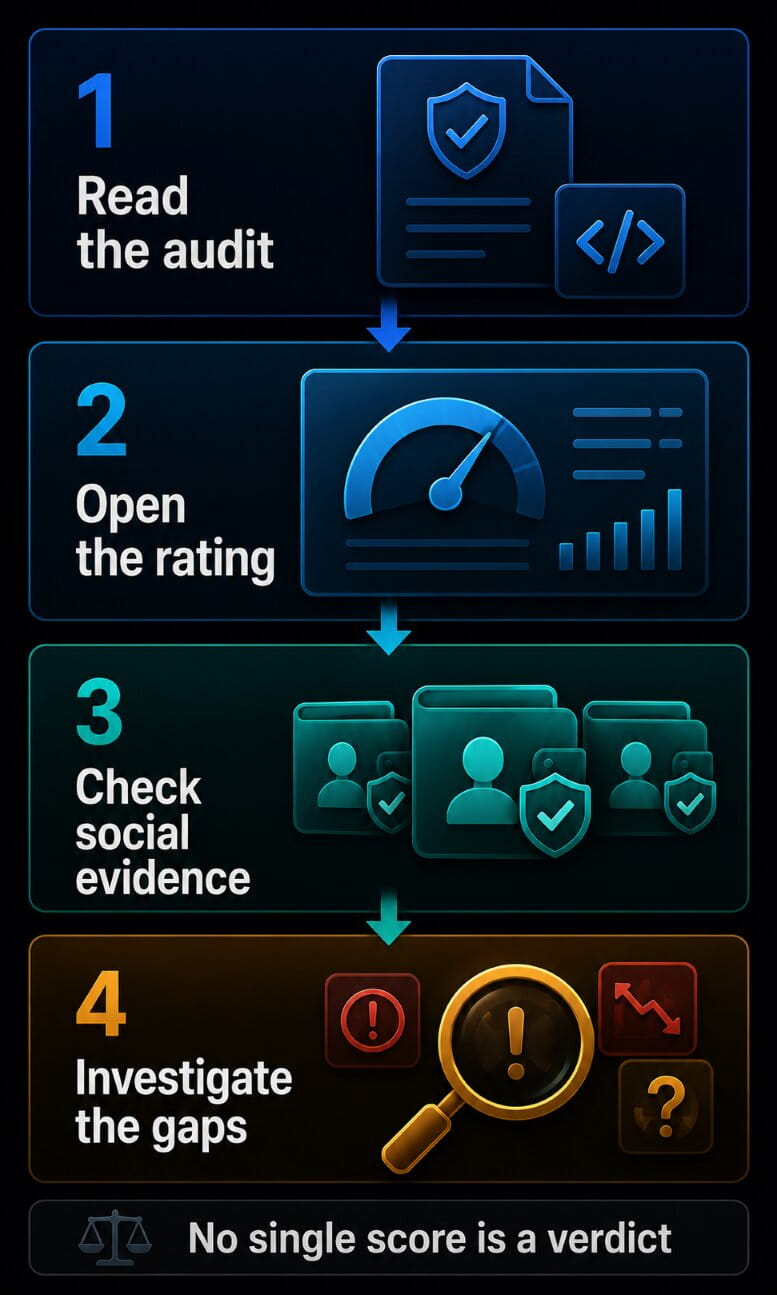
Step 1: Read the Code and Audit Layer
Start with the actual audit report, not the badge displayed on the project’s website. Check the auditor, audit date, contract addresses, audited commit, scope, critical and high severity findings, remediation status, privileged roles, and whether the live contracts still match the reviewed code.
CertiK and Hacken can provide useful technical evidence at this stage, but the auditor’s logo is not the conclusion. A serious reader asks what was audited, what was excluded, what was discovered, what was fixed, and what remains unresolved.
The report matters more than the badge.
Step 2: Read the Public Rating Layer
Next, examine how the public security or risk rating was calculated.
For CertiK Skynet, read the category breakdown rather than relying only on the total score. A strong overall rating may still contain weakness in code security, governance, market activity, operational resilience, or community trust.
For CER.live, check which indicators apply to that type of project. Review whether an audit exists, whether findings were fixed and published, whether the project and code were verified, how relevant and current the audit is, and what incident or security history is included.
Ratings are useful because they compress a large amount of information. They are risky for the same reason. Compression hides scope, uncertainty, and weak inputs. The researcher’s job is to expand the score back into its underlying evidence.
Step 3: Read the Social Audit Layer
Next, examine OGAudit reviews and reviewer consensus rather than relying only on the OG Score.
Look for specific concerns repeated across independent, wallet verified reviewers. These may include unclear team identity, weak product execution, questionable token utility, concentrated supply, unlock pressure, controlled liquidity, artificial community growth, deleted questions, suspicious previous projects, withdrawal problems, or moderators avoiding direct answers.
The strongest community signal is not anger or popularity. It is repeated, specific, and independently supported evidence. One emotional review may be noise. Several experienced reviewers identifying the same pattern are harder to dismiss.
Existing smart contract audits also remain relevant here. OGAudit reviewers may examine published findings, unresolved vulnerabilities, remediation records, privileged controls, and incident history as part of the wider social audit.
Step 4: Investigate the Disagreement
Compare what the technical audit, public rating, and social audit layers are telling you. Agreement across independent layers can strengthen confidence. Disagreement shows where deeper investigation is required.
Strong technical evidence combined with weak community trust may point to concerns around team behavior, token incentives, liquidity control, disclosure, or project execution.
Positive community sentiment combined with weak technical evidence does not remove unresolved vulnerabilities, outdated audit coverage, or dangerous privileged roles.
When evidence is weak across every layer, the honest conclusion is that there is not enough information. Missing evidence should not be interpreted as either safety or fraud.
Do not turn one score into a verdict. Turn the gaps between different layers into a better set of questions.

Conclusion: Use Each Rating Within Its Scope
Crypto ratings are useful only within the limits of what they measure. A high CertiK Skynet score does not prove that a token cannot fail or be rugged. A Hacken audit does not guarantee that every future upgrade, privileged action, or deployment will remain safe. A CER.live rating cannot prove that insiders will not hide supply risk, misuse liquidity, or act against users. A strong OGAudit score does not prove that the underlying code is free from vulnerabilities.
The main failure is scope confusion. Users take one limited signal and treat it as a complete safety verdict. A better approach is layered: examine the technical audit, understand the public security rating, read the community audit, and investigate where the evidence disagrees.
This takes more time than reading a badge or headline score. It also prevents a marketing asset from being mistaken for due diligence.
OGAudit’s role is clear. It is not a code audit firm, a market data site, or a generic review platform. It is a crypto social audit and trust intelligence platform for coins, token projects, centralized exchanges, and the communities using them.
The goal is not to replace CertiK, Hacken, CER.live, or other security providers. It is to add the human, economic, operational, and community layer that technical audits and automated ratings cannot fully capture. That means completing the missing layer that helps prevent crypto scams while giving honest Web3 builders the constructive, evidence-based feedback they deserve.
About the author:
Kripto Raptor is the Chief OG at OGAudit.com and an independent Web3 researcher, blockchain analyst, and entrepreneur. Working full-time in the crypto industry since 2020, he specializes in evaluating Web3 and fintech projects through security analysis, community behavior, and market dynamics. At OGAudit, he publishes data-driven research, crypto social audit reviews, and in-depth project evaluations focused on transparency, risk assessment, and real-world performance. Follow Kripto Raptor on OGAudit, X (Twitter), and LinkedIn.
Frequently Asked Questions About Popular Crypto Scores and Ratings
Is CertiK reliable for checking if a token is safe?
CertiK is useful for checking technical and project risk signals within its methodology. It is not a fraud detector and should not be treated as a guarantee. Read the category breakdown, audit history, report scope, remediation status, and deployed contract evidence. Then compare that technical layer with community evidence before treating the score as meaningful.
What is the difference between Hacken and CER.live?
Hacken provides smart contract audits and other cybersecurity services. CER.live is a separate rating platform within the Hacken ecosystem that organizes visible security evidence into public ratings for coins, tokens, exchanges, wallets, and other crypto platforms. Hacken produces technical assessment evidence, while CER.live evaluates indicators such as audit status, remediation, verification, security controls, and incident history. Neither replaces the social audit layer, which examines team behavior, token incentives, liquidity, execution, user experience, and community trust.
Can crypto ratings be manipulated?
Any rating can be gamed when users only read the headline score. Project-submitted documents can be selective. Badges can be marketed without context. Communities can coordinate sentiment. Manipulation resistance depends on evidence quality, update cadence, methodology transparency, reviewer verification, and whether the project can pay to influence the final output.
Which crypto rating system is most accurate?
Accuracy depends on the question. For code risk, read the audit report and code-focused security evidence. For token security indicators, read the rating methodology and current inputs. For social trust, team risk, tokenomics, liquidity integrity, and reviewer consensus, read verified community reviews. The strongest decision uses all layers and investigates the gaps between them.
What does disagreement between crypto ratings mean?
Disagreement usually means that the systems are measuring different layers of risk. A project may have strong technical evidence but weak community trust, questionable incentives, or poor liquidity controls. It may also have strong community support while carrying unresolved code vulnerabilities or outdated audit coverage. Treat conflicting signals as a reason to investigate further, not as automatic proof that one rating is wrong.
What does a CertiK Skynet score mean?
A CertiK Skynet score is a 0 to 100 project risk rating built from observable on-chain and off-chain indicators across six categories: Code Security, Fundamental Health, Operational Resilience, Governance Strength, Market Dynamic, and Community Trust. It is useful for ongoing monitoring, but it does not verify founder intent or protect users against malicious contract upgrades. Read the category breakdown, not only the total score.
Can a project pay for a better Skynet, CER.live, or OGAudit score?
There is no public evidence that projects can directly buy a numerical score on these platforms, but their commercial structures differ. CertiK and Hacken sell security services, and audit-related evidence can feed into Skynet and CER.live ratings. On OGAudit, projects cannot pay to change an OG Score, remove reviews, or buy a better ranking. Scores come from independent, wallet-verified Crypto OGs.
Can a project with a high security rating still rug pull?
Yes. A high Skynet score or CER.live rating reflects the evidence its methodology can see, such as audit status, remediation, and observable on-chain signals. It cannot rule out a malicious upgrade, abuse of admin keys, or insiders draining liquidity, as the Swaprum and Merlin cases above show. Check who controls upgrades and liquidity before trusting any rating.


