
Trending Coins and Tokens🔥


Crypto
Exchange

Ultimate Guide to EVM Wallet Addresses: Uniqueness, Functionality, Security, and Best Practices

Blockchain technology is heralding a new era of financial autonomy and decentralized applications. Central to this revolution are digital wallets, particularly those based on the Ethereum Virtual Machine (EVM). If you've operated on Ethereum or its compatible blockchains like Binance Smart Chain or Polygon, you’ve likely encountered EVM wallet addresses, prominently identifiable by their 0x prefix. Understanding how these addresses function, their significance, and the best practices around them is crucial for blockchain safety and functionality.
This comprehensive guide unpacks the technical, practical, and security aspects of EVM wallet addresses to educate both beginners and experienced users.
What Makes EVM Wallet Addresses Unique?
Core Features
An EVM wallet address is a 42-character string derived from a process involving private and public keys. Key characteristics include:
-
Hexadecimal Format and Checksumming: Addresses are represented in hexadecimal, and the checksum feature (as implemented in Ethereum's EIP-55 standard) helps detect typographical mistakes.
-
Cryptographic Foundations: These addresses are outputs of encryption algorithms like Elliptic Curve Digital Signature Algorithm (ECDSA) and Keccak-256 hashing. The private key generates the public key, which is subsequently hashed to produce the wallet address.
Comparison With Non-EVM Wallets
Bitcoin and Ethereum employ differing address formats:
-
Bitcoin uses Base58 encoding, which omits ambiguous characters like 1 and I, making it more human-readable but less automated-compatible than EVM's hexadecimal system.
-
Ethereum addresses are case-sensitive when using checksums, while Bitcoin’s format requires fewer manual validations.
Key Insight: The use of hexadecimal in EVM makes addresses machine-friendly and enables scalability across applications.
Reference: Learn more about EIP-55 checksum standards here.
EVM Wallet Address vs. Bitcoin Address
Structural Differences 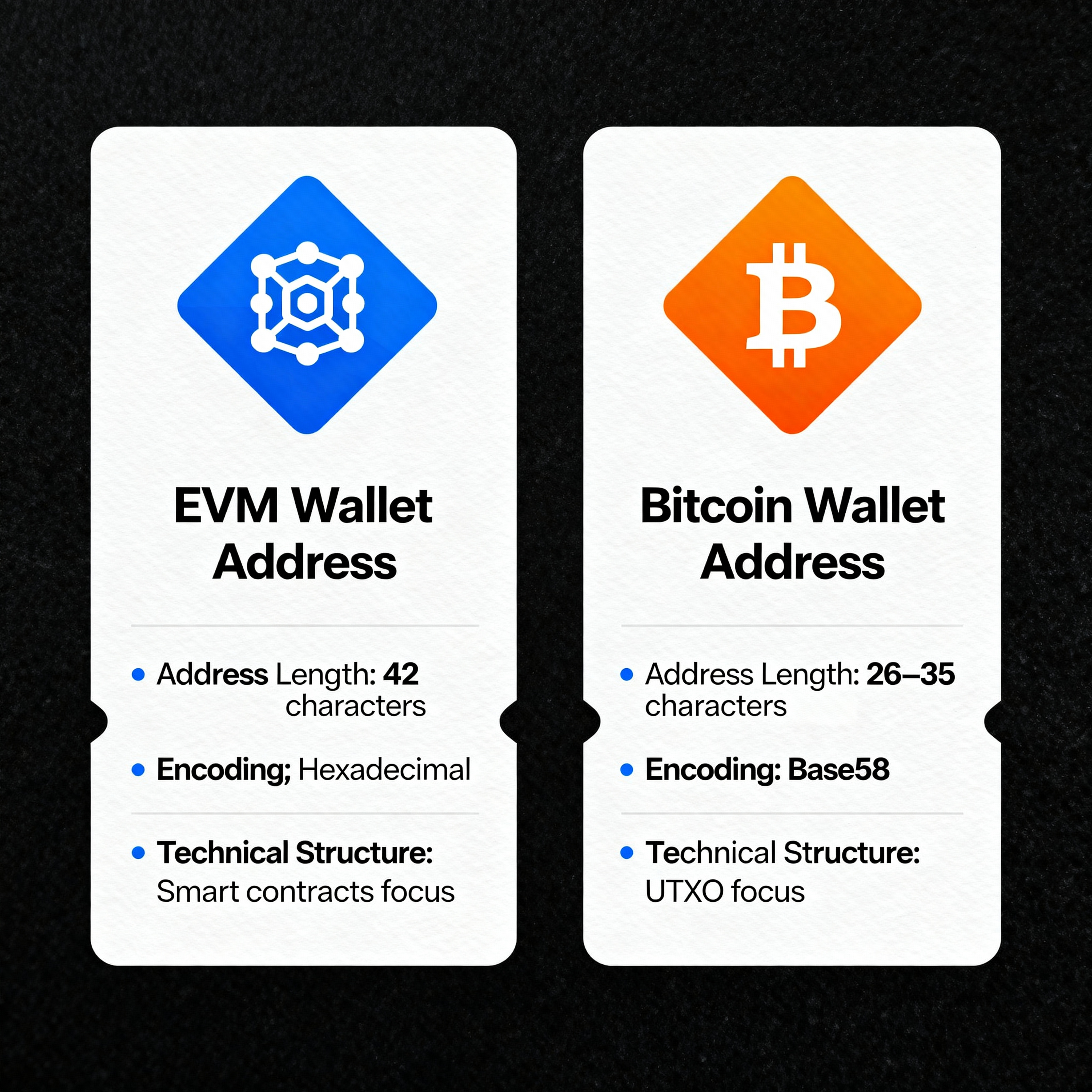
-
Address Length:
-
EVM: Fixed at 42 characters (including 0x).
-
Bitcoin: Varies but typically 26-35 characters.
-
-
Encoding:
-
EVM: Hexadecimal format.
-
Bitcoin: Base58 for simplicity.
-
-
Bitcoin Wallet Examples:
-
Legacy Address (P2PKH): Starts with 1. Example: 1A1zP1eP5QGefi2DMPTfTL5SLmv7DivfNa (Satoshi Nakamoto's wallet address).
-
SegWit Address (P2SH): Starts with 3. Example: 3J98t1WpEZ73CNmQviecrnyiWrnqRhWNLy
-
Bech32 Address (Native SegWit): Starts with bc1. Example: bc1qw508d6qejxtdg4y5r3zarvaryvqyzf3duf0d34.
-
-
EVM Wallet Address Example:
-
Ethereum Address: Always begins with 0x, followed by 40 hexadecimal characters. Example: 0xde0B295669a9FD93d5F28D9Ec85E40f4cb697BAe.
-
Technical Implications
The inherent differences reflect the design philosophies of Ethereum (smart-contract-first) vs. Bitcoin (store-of-value-first). For instance:
-
Bitcoin addresses often represent unspent transaction outputs, while EVM addresses interact with tokens and smart contracts.
Recommendation for Beginners: Always start by familiarizing yourself with EVM addresses if engaging in DeFi or NFTs.
Why Do EVM Wallet Addresses Start With 0x?
The prefix 0x is not a functional part of the address but serves as an identifier. It signifies that the associated address is in hexadecimal format, ensuring easy distinction in blockchain transactions. For example, without it, interpreting complex alphanumeric sequences could become ambiguous when switching between blockchains or applications.
Technical Note: While primarily serving readability, some smart contracts require the 0x prefix to parse addresses successfully.
How to Safely Use EVM Wallets in Transactions
Step-by-Step Safety Tips
-
Double-Check the Address:
-
Always copy-paste addresses; manual entry increases the risk of errors.
-
Verify checksum capitalization in addresses.
-
-
Cross-Check the Blockchain Network:
-
Ensure compatibility between assets and the network. For instance, sending Ethereum (ETH) on the Binance Smart Chain network can lead to permanent loss of funds unless recovered manually.
-
-
Seed Phrase Management:
-
Store recovered phrases offline, never share them digitally. Use secure storage like metal plates for longevity.
-
-
Use QR Codes for Input:
-
When possible, scan QR codes rather than copying to clipboard to reduce phishing attacks.
-
Important Tip: Wallet apps like MetaMask feature error messages for incorrect transactions. Use these to verify issues early.
External Guide Reference: www.ledger.com
Why Do Some Blockchain Wallets Require a Memo or Tag?
When dealing with certain blockchain networks like Binance Chain (BNB), Stellar (XLM), or Ripple (XRP), you are often required to include a Memo or Tag alongside the wallet address in your transactions. While this may seem unusual for users familiar with Ethereum and its EVM-compatible networks, it serves a functional purpose.
Purpose of Memos/Tags
-
Identifying Users on Custodial Platforms: In centralized exchanges, all users’ funds are stored in shared wallets to optimize address usage. A memo/tag acts as a unique identifier to associate your transaction with your account.
-
Streamlining Transactions: Blockchain infrastructure like Stellar or Ripple integrates memos to ensure efficient routing of transactions without creating millions of individual addresses.
-
Avoiding Duplication: By using memos, blockchain systems designed with batch addresses avoid unnecessary address generation for each user while maintaining scalability.
For instance:
-
Binance Coin (BNB) often requires a “destination tag.”
-
In XRP transactions, “tag” identifies the recipient's account.
Best Practices for Memos/Tags in Wallets
Risks Involved
Failing to include a memo/tag in certain transactions can lead to funds being lost or delayed, especially when sending funds to centralized exchanges. Similarly, incorrect memos could redirect your funds to another user's account or render them irretrievable.
Handling Memo/Tag Information Responsibly
-
Double-check List Requirements: Each blockchain may have different tagging protocols. For example:
-
XRP uses a "destination tag."
-
Binance Chain uses a "memo."
-
-
Always Include Memo/Tag When Required: Always read the recipient’s requirements before submitting a transaction.
-
Test the Transaction First: Before a major transfer involving memos/tags, test with a small trial transfer.
Tip: Many modern wallets auto-prompt for tags where necessary. UIs like Trust Wallet, Ledger, and MetaMask (if configured for Binance or Stellar) help mitigate these errors.
How to Avoid Fund Loss With EVM Wallet Addresses
Preventative Measures
-
Run Test Transactions:
-
Send small amounts before transferring all assets.
-
-
Use Address Books:
-
Most modern wallets allow saving frequent addresses, minimizing errors.
-
-
Leverage Hardware Wallets:
-
A Ledger or Trezor ensures your private keys never touch online environments.
-
Recovery Options
Accidentally sent funds? While blockchain transactions are irreversible, you can:
-
Contact your wallet provider for assistance, or browse blockchain explorers to manually track where the funds went and try sending some on-chain messages to request a refund. Some leading blockchain explorers for reference:
Mempool for Bitcoin, Solscan for tracking Solana network Transactions, Etherscan (v2 supports Ethereum and more EVM networks), And Debank for a unified portfoilo tracking across all EVM networks) -
If you accidentally sent funds to a custodial service provider or crypto exchange, they may be able to assist with recovering them. Wallets commonly used by exchanges and institutions are often labeled on Arkham Intel’s tracking and analytics platform. Learn more at: https://intel.arkm.com/
-
Warning: Many scammers try to pose as helpers and attempt to scam users by pretending to assist with fund recovery. Ignore all unsolicited messages you receive. At this stage, you must proceed on your own and remain extremely cautious of potential scammers.
Dead Wallets: How Burn Addresses Work and Their Impact
-
What Are Dead Wallets?
-
Dead wallets, also referred to as burn wallets, are addresses used to render assets inaccessible permanently. Typically, these wallets lack private keys, making it impossible for anyone to retrieve funds sent to them. They ensure a permanent reduction in circulating supply.
-
-
How They Work:
-
Users send tokens or cryptocurrency to an address specifically designated for burning purposes. Once sent, those assets become irretrievable and are officially removed from circulation. For instance, Ethereum addresses 0x000000000000000000000000000000000000dead and 0x0000000000000000000000000000000000000000 are commonly used burn wallets.
-
-
Real-Life Example:
-
Ethereum Improvement Proposals (EIPs), such as EIP-1559, use burning mechanisms to destroy a portion of the transaction fees paid in ETH, reducing circulating supply and introducing deflationary pressure.
-
EVM Wallet Addresses in Multi-Chain Usage
Interoperability
A unique aspect of EVM architecture is its cross-chain compatibility. Addresses generated on Ethereum can also work on Binance Smart Chain (BSC) or Polygon, provided you configure the wallet correctly within the interface, such as modifying network RPC details in wallets like MetaMask.
Risks
-
Network Confusion: Sending ETH to BSC without configuring the bridge causes fund retrieval challenges.
-
Token Standards: Each chain may have unique token representations, leading to display errors if unsupported standards are ported.
Pro Tip: Use tools like bridges or multi-chain protocols to manage EVM-compatible movements effectively.
Security Best Practices for EVM Wallet Addresses
Core Practices 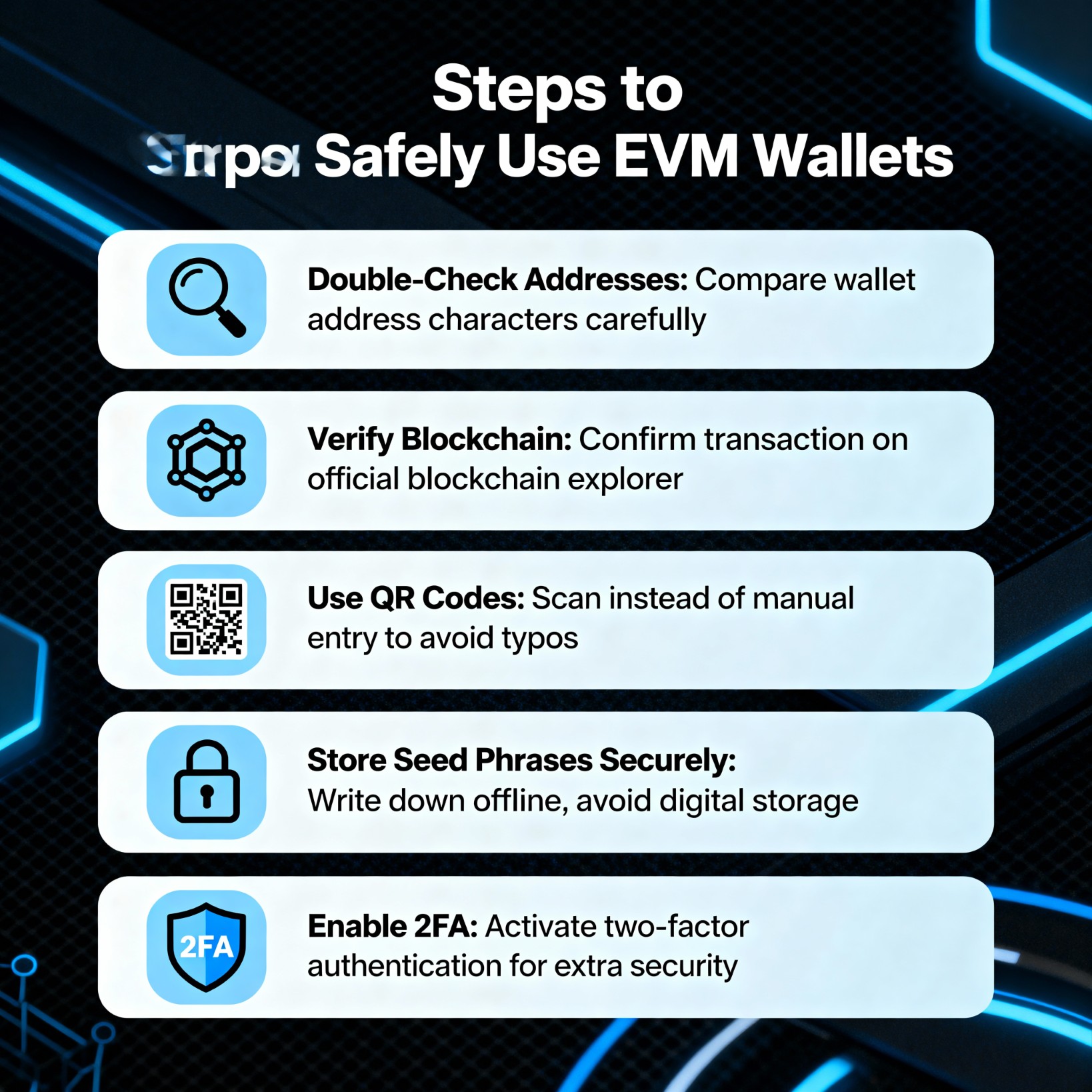
-
Private Key Management: Never share your private key; hardware wallets are ideal.
-
Malware Protection: Leverage anti-virus and ensure systems are air-gapped.
-
Avoiding Phishing Attempts: Phishing attacks often mimic genuine addresses or interfaces.
-
QR Codes: QR Codes may prove useful in quickly entering adresses, but NEVER use a QR code of unknown origin.
Advanced Mechanisms
-
Social Recovery Wallets:
-
Innovations like Multi-Party Computation (MPC) wallets ensure security without exposing private keys to every participant via threshold signatures.
-
-
Account Abstraction (ERC-4337):
-
By abstracting key-based logic into smart account modules, users gain additional configurations, such as programmable gas.
-
Learn more about these concepts in hacken.io.
Conclusion
EVM wallet addresses offer unmatched utility in a blockchain-based ecosystem. Their technical design, rooted in cryptography, ensures scalability and interoperability across decentralized applications and networks. As user adoption continues to rise, understanding their nuances ensures safer interactions and mitigates errors.
Adopting practices like hardware wallets, double-checking network settings, and leveraging cross-chain bridges will prepare you for the multifaceted world of blockchain transactions.
Whether you're a beginner stepping into DeFi or an expert deploying smart contracts, familiarity with EVM wallet addresses is indispensable.
Stay Informed, Stay Secure.


